
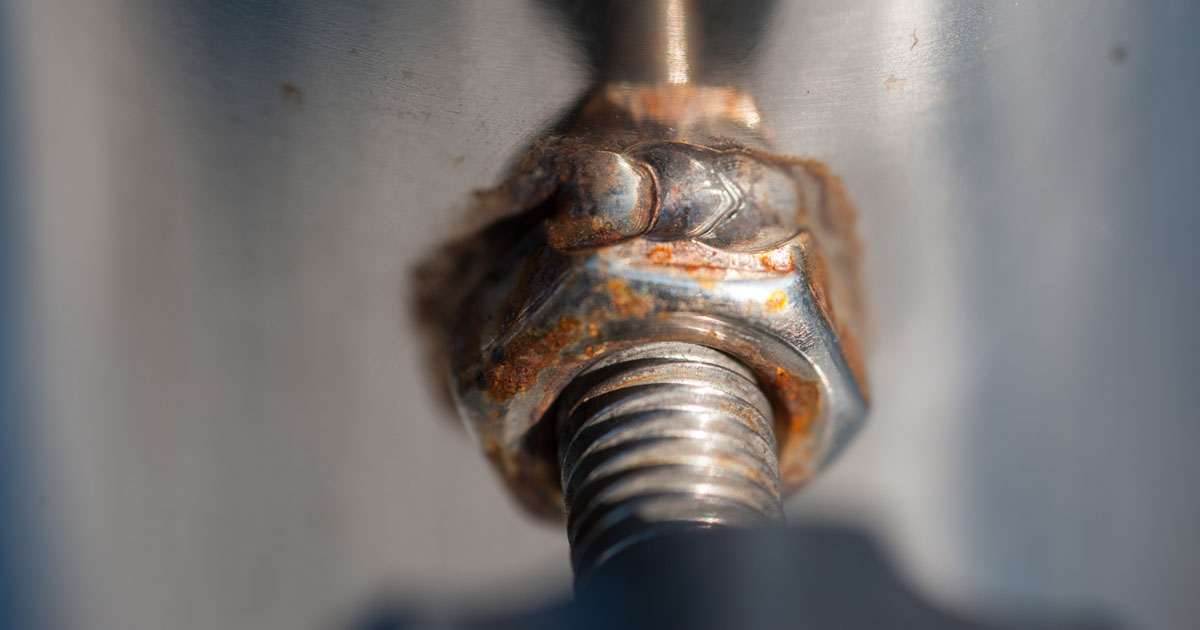
On the subject of corrosion protection we can speak of passive (e.g. protective coatings) and active (corrosion-resistant raw materials) corrosion protection.
Austenitic stainless and acid-resistant steels, such as the A2 and A4 screw raw materials, belong — because of their alloying materials (Cr, Ni, Ti, Nb, Mo, etc.) — in the category of “active” corrosion protection.
These stainless and acid-resistant steels contain at least 16% chromium (Cr) and resist oxidising substances. Increasing the content of chromium (Cr) and, as required, of other alloying elements such as nickel (Ni), molybdenum (Mo), titanium (Ti) and niobium (Nb) increases the resistance to corrosion. These additives also have an effect on the mechanical properties of the material, which we experience depending on the use. Other alloying elements are only applied for the purpose of further improving the mechanical properties (e.g. nitrogen, N) or of removing contaminants (sulphur, S).
Austenitic stainless and acid-resistant steels are not generally characterised by magnetisability; nevertheless, during cold forming the material work-hardens and may also become permanently magnetised. This, however, has no effect on its resistance to corrosion.
In practice stainless and acid-resistant steels can also corrode in various ways, the most common forms of which can be seen in the figure. A more detailed description of the individual cases can be read below:
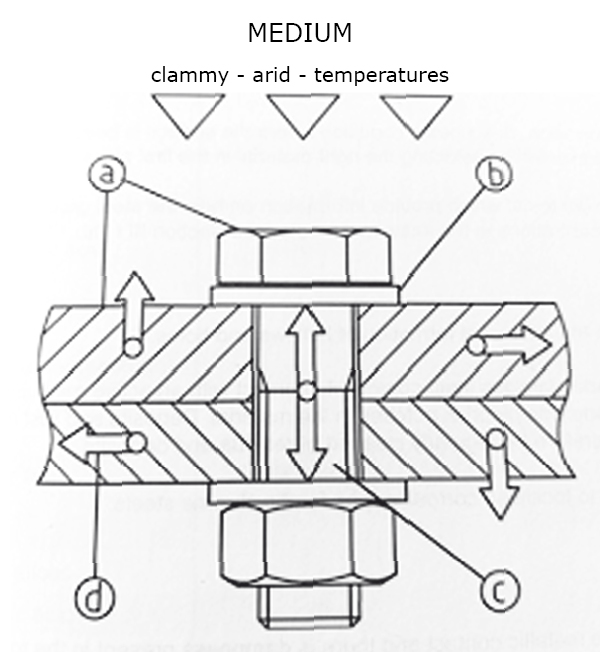
- a.Types of corrosion appearing on the surface, e.g.:
- rust contamination
- surface corrosion
- local corrosion
- b.contact corrosion
- c.stress and
- d.mechanical factors
01Rust contamination
When carbon steel (“normal steel”) particles adhere to a stainless or acid-resistant steel surface, then in their presence rust spots first develop, and then, on contact with oxygen, extensive rust may arise. If these areas are not cleaned or removed, this may cause local, electrochemical corrosion of the austenitic steel.
Possible causes of its development:
- the use of tools that have previously also been used on carbon steel
- the deposition of glowing metal particles formed during the use of an angle grinder or during welding
- rusty metal objects (e.g. rusty pieces of iron, screws, vessels, etc.) that somehow come into interaction with the surface of the stainless Or acid-resistant steel
- carbon steel particles washed on by water…
02Surface corrosion
This is the condition in which the surface rusts uniformly. It can be eliminated by selecting the appropriate raw material. Laboratory test results are available on the resistance of steels to various chemicals, taking into account their concentration and temperature.
03Local corrosion
Corrosion spots, pits or cavities are visible on the surface. It can develop, for example, in the humid or splash zone of chlorine-containing substances (e.g. around swimming pools). Various contaminants and rust deposits can also trigger local corrosion, therefore fasteners must be regularly cleaned of such deposits.
04Contact corrosion
When we create direct contact between metals of different composition in a damp environment, an electrolyte comes into being and contact corrosion appears, in which the anode (the more positive side) is destroyed.
In order to avoid this, let us take care of the following:
- Let us avoid the possibility of an electrolytic medium developing
- Let us insulate the contact points with rubber, plastic or some other coating, preventing the direct contact of metals with different potentials
- Let us avoid the combination of differing materials wherever possible, and among other things let us match the screws, nuts and washers in grade to the material of the connected structural elements
05Stress corrosion
The internal stress arising during the welding of materials can also cause corrosion. This type of corrosion phenomenon can be observed mostly in industrial environments where the materials are exposed to significant mechanical tensile and straining forces.
Austenitic steels are particularly sensitive to stress corrosion in a chlorine-containing medium. In this respect the temperature factor is of prominent significance; 50°C, for example, is already a critical range.
06Mechanical corrosion
During mechanical machining — for example in the areas affected by drilling, sanding, grinding or other cold forming, where the surface oxide layer protecting the austenitic steel is damaged — rust may appear. Passivating agents, which accelerate the restoration of the surface oxide layer, offer recommended solutions for eliminating it.

Leave a Reply