
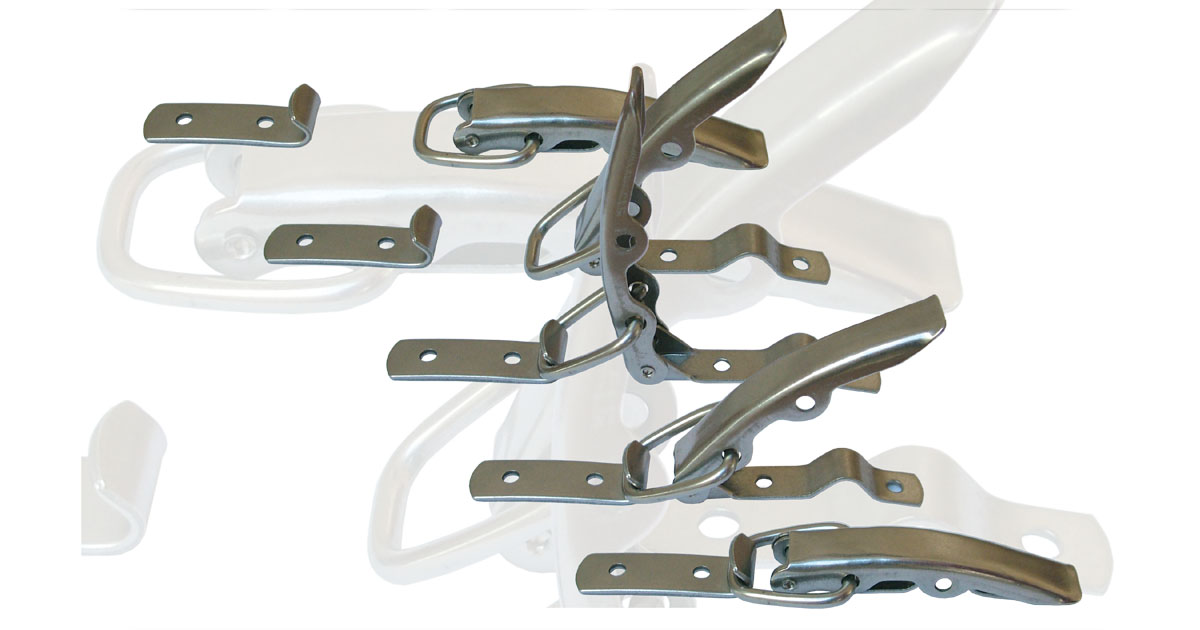
We are modern people. We like solutions that are quick, simple and splendid. Who wants to thread and screw things together nowadays if they don’t have to? We like hearing that little metallic snap – the “click-clack and click”. You can’t sell a film these days without those sound effects, and if they turn up in the trailer too, at the right volume of course, while the cast move at lightning speed and with total conviction, they grab our attention at once. Anything you can clip on or release in a single movement is exciting; everyone picks it up, looks at it, tries it. Anything lacking that quality is boring and outdated – provided, of course, it opens and closes at all, like a tarpaulin, a pressure cooker, a boot, a walking boot, a pannier, a fitting, a tank lid, a machine cover, a sports car, a watch strap, a strap, a trailer and so on. Securing something in one movement – now that’s something. That’s where things start. And they carry on with releasing, loosening and opening it being a single easy movement too. Despite all of which, the fastening is still expected to be stable, solid and load-bearing. It should resist wind, pressure and resonance, and its material should be strong and durable. Sometimes there is no room for it, yet it has to fit anyway. Or there is room, but the fastening element should be graceful and discreet, blending into its surroundings. The needs are as varied as the solutions, even though the fastening method we are talking about falls broadly into one category: the category of toggle latches. In Hungarian they are called “frog locks”, though they have about as much to do with frogs as a hot dog has with a dog – and yet the name is vivid.
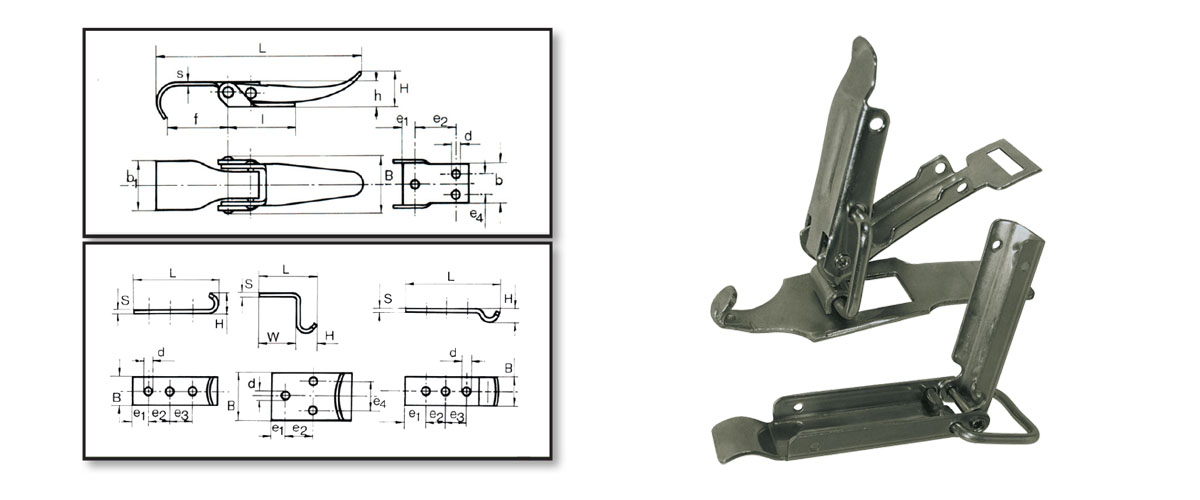
In most cases a toggle latch consists of 2 parts: the main part that swings over, and the counterpart, which may be a simple back-bent plate. In some cases you don’t even need a counterpart, if the closing surface has some kind of lip formed on it for the purpose – as with a fluorescent light fitting, for example. Push the latch’s securing loop forward in one movement, hook it into the lip formed for it on the other part, then pull it firmly back with the same lever so the surfaces close tightly, and bring the operating lever – accompanied by a click – into a stable resting position. That’s all. An extra feature can be that the toggle latch can also be locked once closed, and there are of course solutions for that requirement too. The elements to be fastened this way may sit at various angles to one another, from 180° through 90° to special shapes, and they may even be curved, like the lid of a barrel. In that case the main part and the counterpart can be one and the same fastening element, held together by a curved strap of appropriate length – and, naturally, part of this logic is that “the snake bites its own tail”… Designers have also solved cases where a lid has to be fastened at several points, where it cannot be positioned in exactly the same way at every fastening point, or where its later movement makes it necessary for the fastenings to be adjustable or perhaps self-aligning.
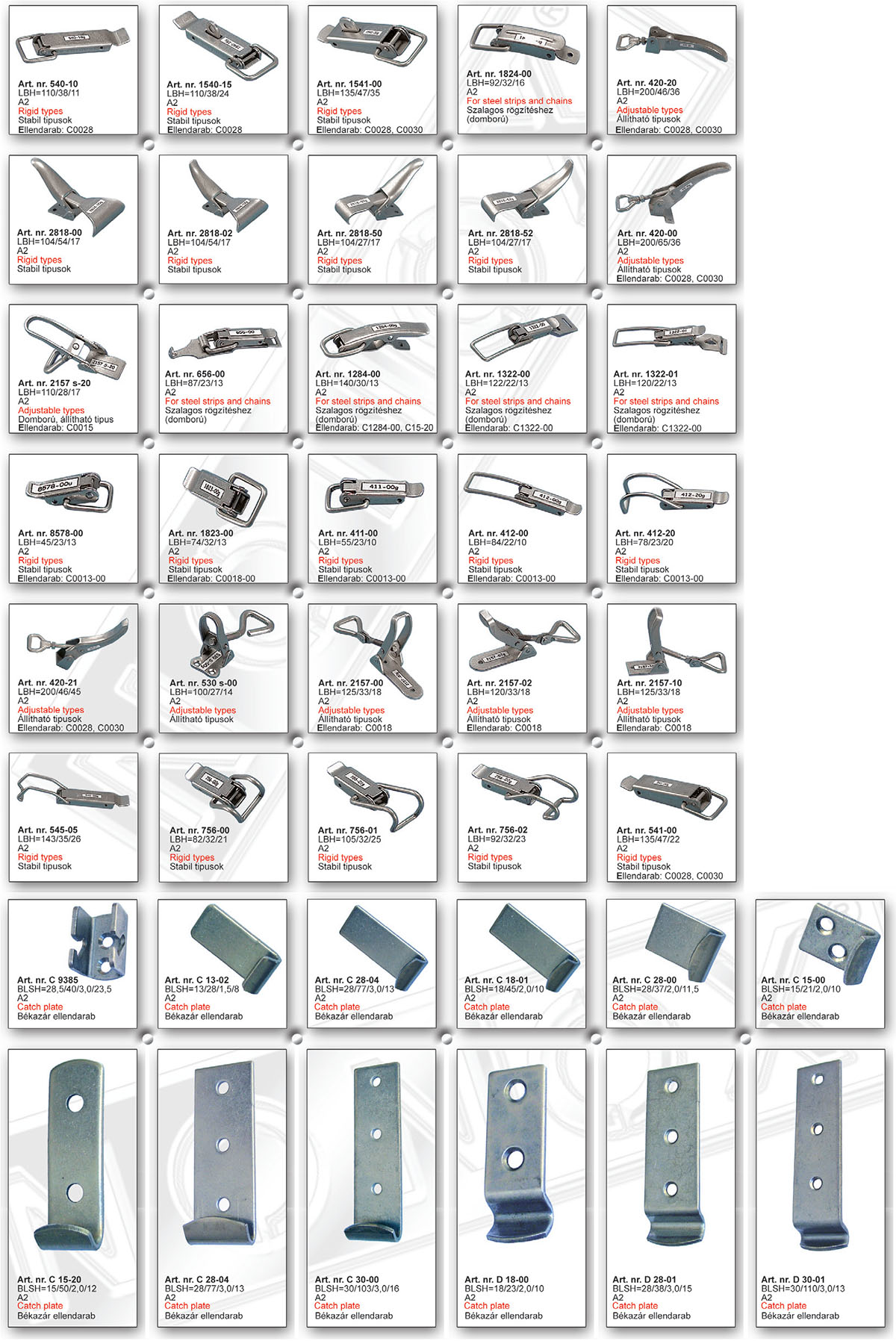
Our NONOX stainless and acid-resistant toggle latches are made of stainless and acid-resistant steel, just like every other member of our fastener range. If you like quick and simple solutions, take a look through our toggle latches. The main dimensions of toggle latches are L, B and H – that is, length, width and height – but you will find other important data in our online shop as well. If you can’t find what you are looking for, ask our sales team for help!
- Our toggle latches:Toggle latches
- Counterparts:Toggle latches – counterparts

Leave a Reply