
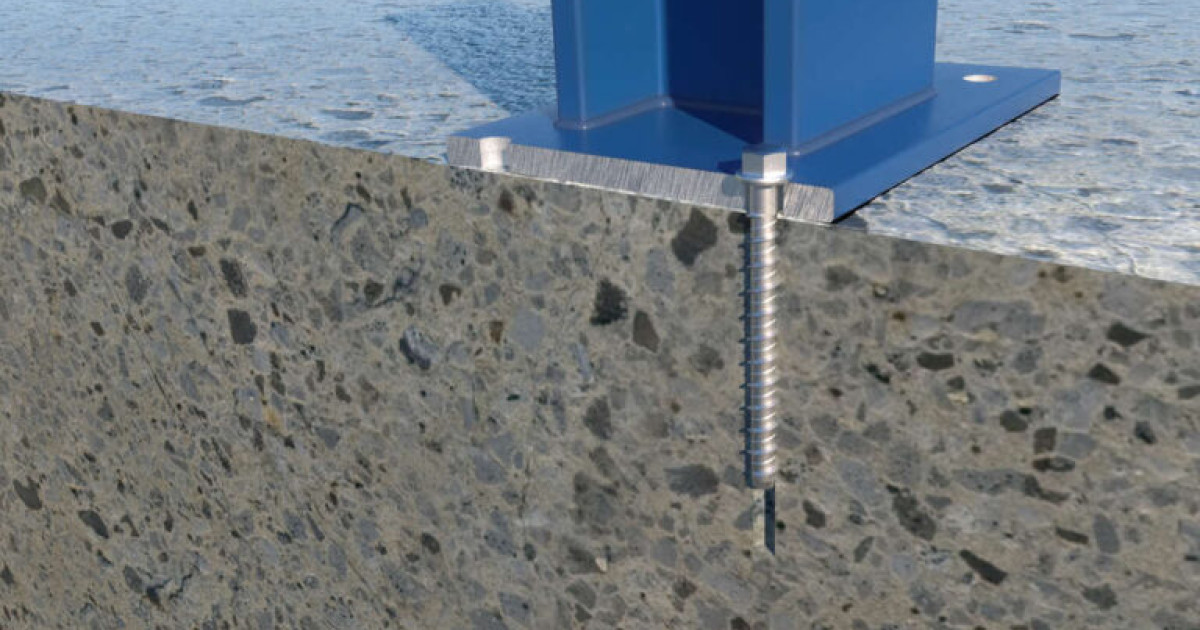
CONCRETE SCREWS IN PRACTICE
What can ATLANTIS-coated INDEX concrete screws do?
Subsequent fixing to concrete was for a long time a fairly one-sided world: wall plugs, bonded-in threaded rods, with various compromises. Contractors got used to this, lived with it, and in many cases these still represent the best solution today. In recent years, however, concrete screws have gained more and more ground, and this is no accident at all.
Modern concrete screws are fast, strong and well documented, and in certain applications they are a decidedly practical alternative, especially where what matters is:
- fast installation,
- predictable fixing,
- the ability to dismantle afterwards,
- or precisely the use of a higher-strength steel fastener.
The ATLANTIS-coated concrete screws of INDEX fall exactly into this category.
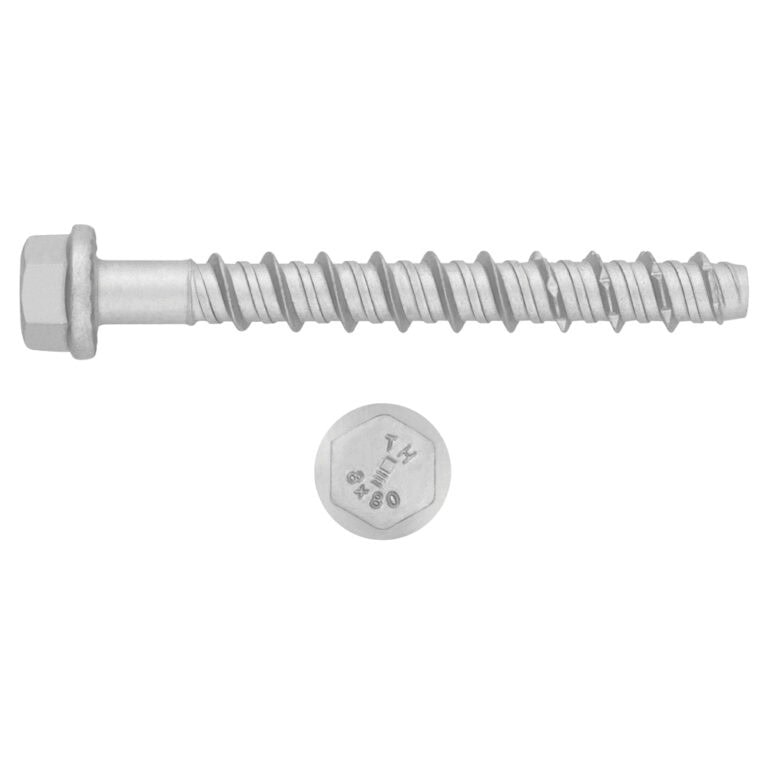
What in fact is a concrete screw?
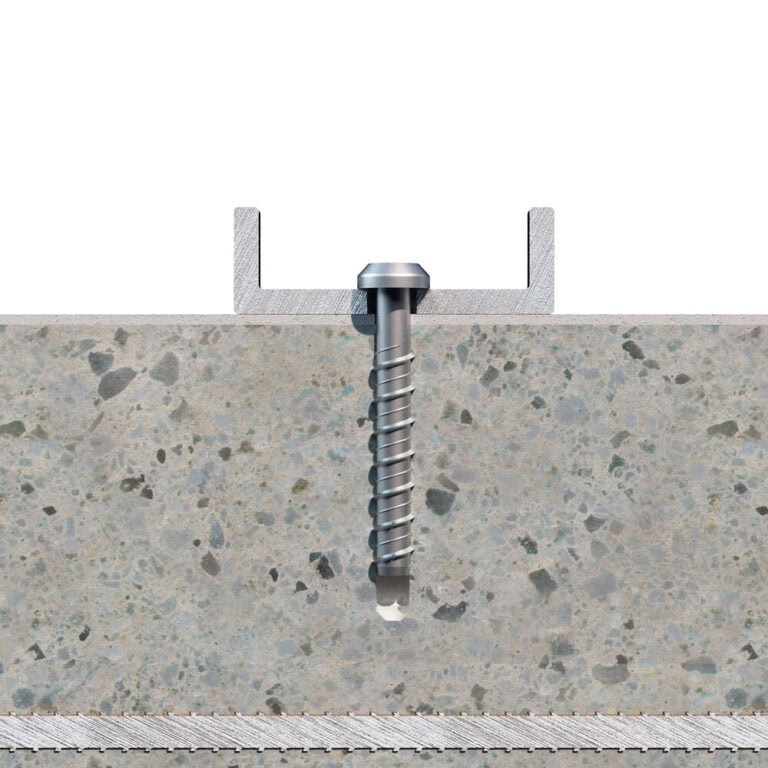
The concrete screw is a fixing element with a special thread geometry, which is driven into a pre-drilled hole. The essence of its operation is that it does not grip with the help of a separate wall plug, but forms a thread connection in the concrete itself. This connection comes about along the entire embedment depth, which is why the character of the fixing differs completely from that of conventional wall plugs.
The concrete screw:
- does not expand,
- fixes evenly over the full depth,
- is quick to install, and
- can, if necessary, be completely dismantled and, within certain limits, even refitted.
This last can be particularly interesting for temporary fixings, for auxiliary assembly structures or for systems that have to be modified from time to time.
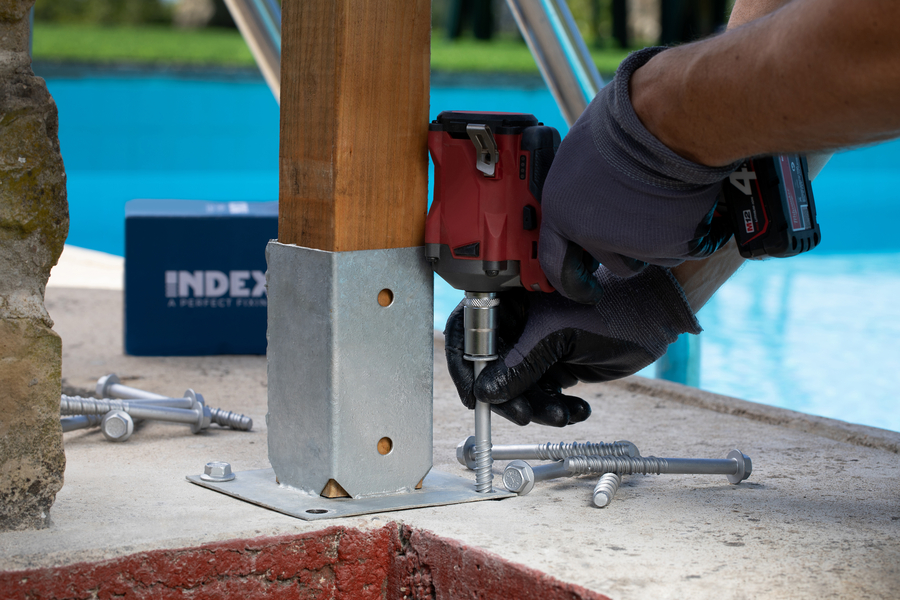
How does the concrete screw work?
The concrete screw does not grip with a separate wall plug, but forms a thread connection in the concrete itself while being driven in, which is why the fixing comes about along the entire embedment depth.
This is a fundamentally different operating principle from
- that of wall plugs expanding at a single point,
- or that of bonded-in screws.
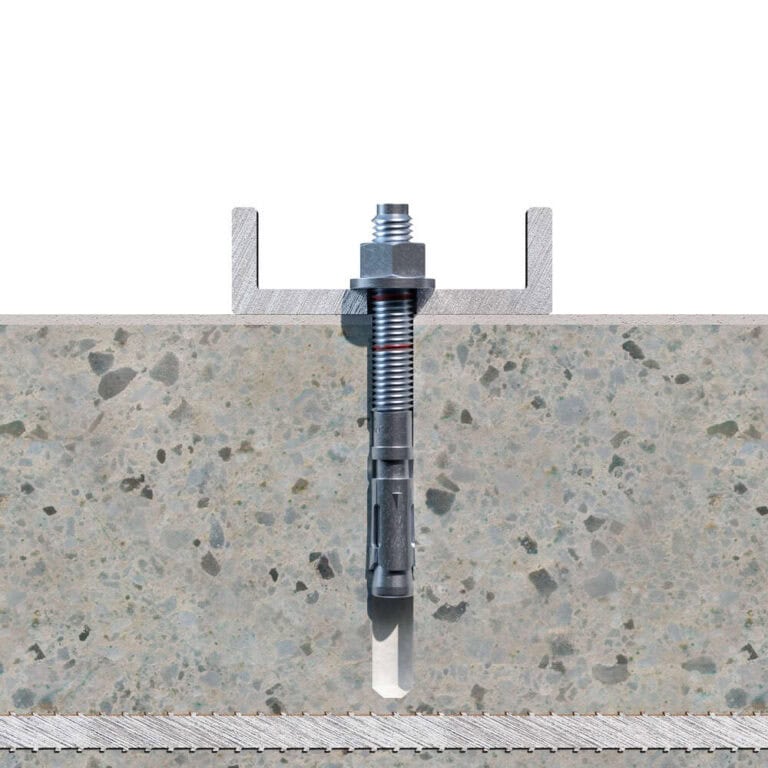
Chemical anchor, wall plug or concrete screw?
This is not an “either-or” question. Every system has its own place.
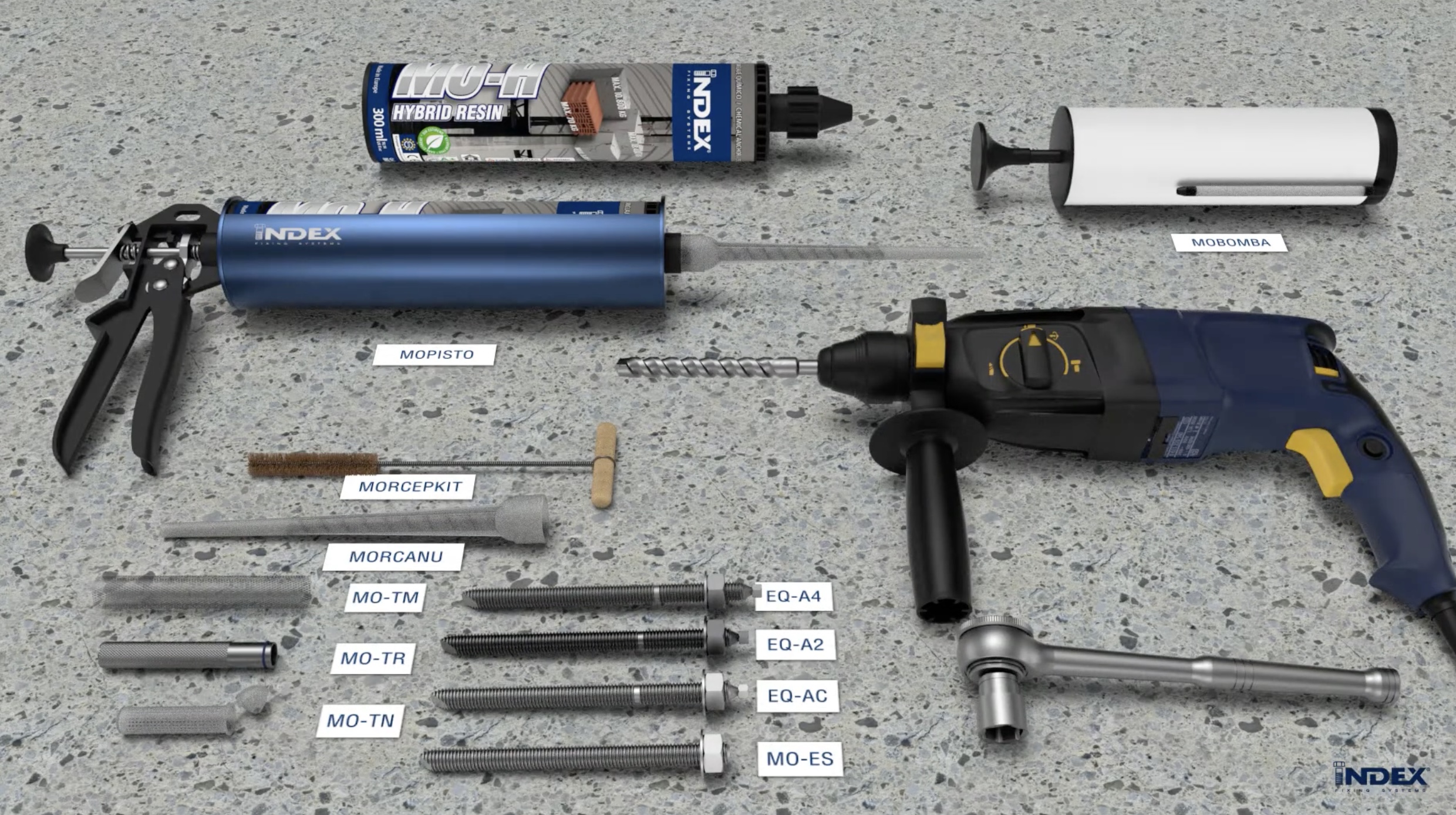
Bonded systems, for example, continue to play an extremely important role in modern fixing technology, particularly
- – in fresh concrete,
- – close to narrow edges,
- – on horizontal surfaces, and we could go on…
Bonding fixes over a larger surface than mechanical solutions, and in certain cases it is less sensitive to minor inaccuracies in the pre-drilling.
We consider the chemical anchors of INDEX a decidedly good solution for these applications.
With bonded systems, on the other hand, you have to reckon with:
- – curing time,
- – temperature-dependent hardening,
- – the need for cleaning,
- – and with the fact that bonded-in fixing elements can no longer — or not entirely — be removed afterwards.
The conventional wall plugs can likewise be used very well in numerous applications. They are fast, economical and represent a well-proven solution, but their operation is based on expansion at a single point.
In certain situations this can be a limiting factor:
- – with fixings close to edges,
- – at narrow edges,
- – with smaller concrete thicknesses,
- – or with structures more sensitive to cracking.
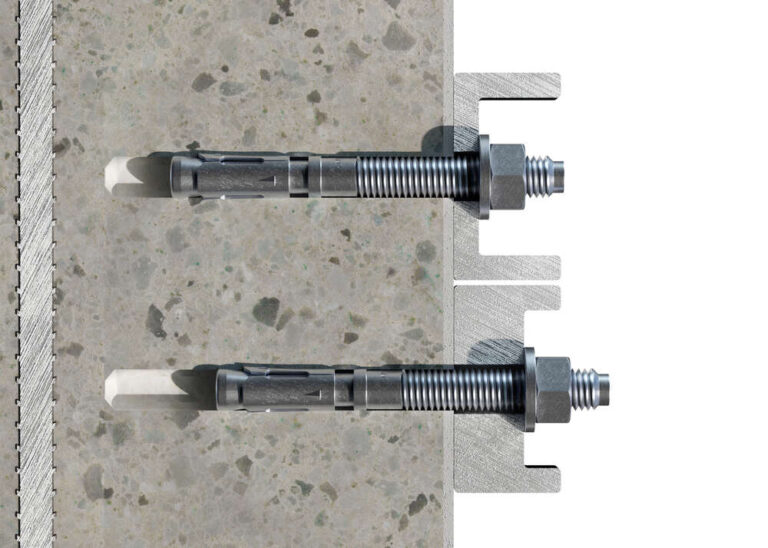
One of the great advantages of concrete screws is precisely that they do not expand, but work with a thread connection.
Why do contractors like concrete screws?
Because the work is fast with them.
- There is no curing time.
- There is no separate wall plug.
- There is no need to coordinate several kinds of component.
After a well-made hole, the installation can be carried out practically in moments.
This is not only a question of convenience.
In the case of larger projects:
- – the installation time,
- – the repeatability,
- – the reduction of the scope for error,
- – and the simpler execution
- – become very serious factors.
The majority of contractors are not necessarily looking for the most complicated systems, but for what is:
- – fast,
- – predictable,
- – productive,
- – and reliable in the long term as well.
The popularity of concrete screws stems partly from exactly this.
ATLANTIS coating — not stainless, but serious protection
It is important to clarify that ATLANTIS-coated concrete screws are not made of stainless steel, nor are they intended to replace inox systems in an aggressive environment.
In a marine environment, under heavy chemical load or in persistently extreme corrosion conditions, acid-resistant fasteners continue to be the primary solution.
There are, however, many applications where:
- – a high-strength steel fastener is needed,
- – corrosion protection is important,
- – it is intended for outdoor use,
- – but a fully stainless system is not justified.
It is in such cases that the ATLANTIS coating becomes really interesting.
What is the ATLANTIS coating?
ATLANTIS is a multi-layer corrosion protection system.
Its structure:
- – zinc base layer,
- – special passivating layer,
- – then a multi-layer epoxy-based organic coating.
The aim of the system is not merely that “it should not rust”.
Concrete screws:
- – are driven into concrete,
- – are subjected to mechanical load,
- – are used in an outdoor environment,
- – and in many cases remain under load for years.
In such cases the quality of the coating is particularly important.
According to the manufacturer, ATLANTIS:
- – has excellent salt spray test results,
- – provides good scratch resistance,
- – resists acidic and alkaline environments,
- – is Cr(VI)-free,
- – is REACH and RoHS compatible,
- – and does not cause hydrogen embrittlement problems.
This last is particularly important with high-strength steel fasteners.
Hot-dip galvanised or ATLANTIS?
ATLANTIS-coated concrete screws can be a good alternative:
- – for fixing hot-dip galvanised elements,
- – for galvanised structures,
- – and in places where a higher-strength fastener is needed.
The choice of the appropriate system is always a function of:
- – the environment,
- – the load,
- – and the conditions of application.
What does the C3-H corrosion category mean?
The C3 corrosion category generally means:
- – an outdoor,
- – moderately polluted,
- – normal humidity-load environment.
The “H” marking refers to a higher durability level.
This can typically be of interest in environments such as:
- – industrial halls,
- – outdoor mechanical services systems,
- – steel structures,
- – urban outdoor installations.
Why does the head shape matter?
With concrete screws the head design is by no means only a question of aesthetics.
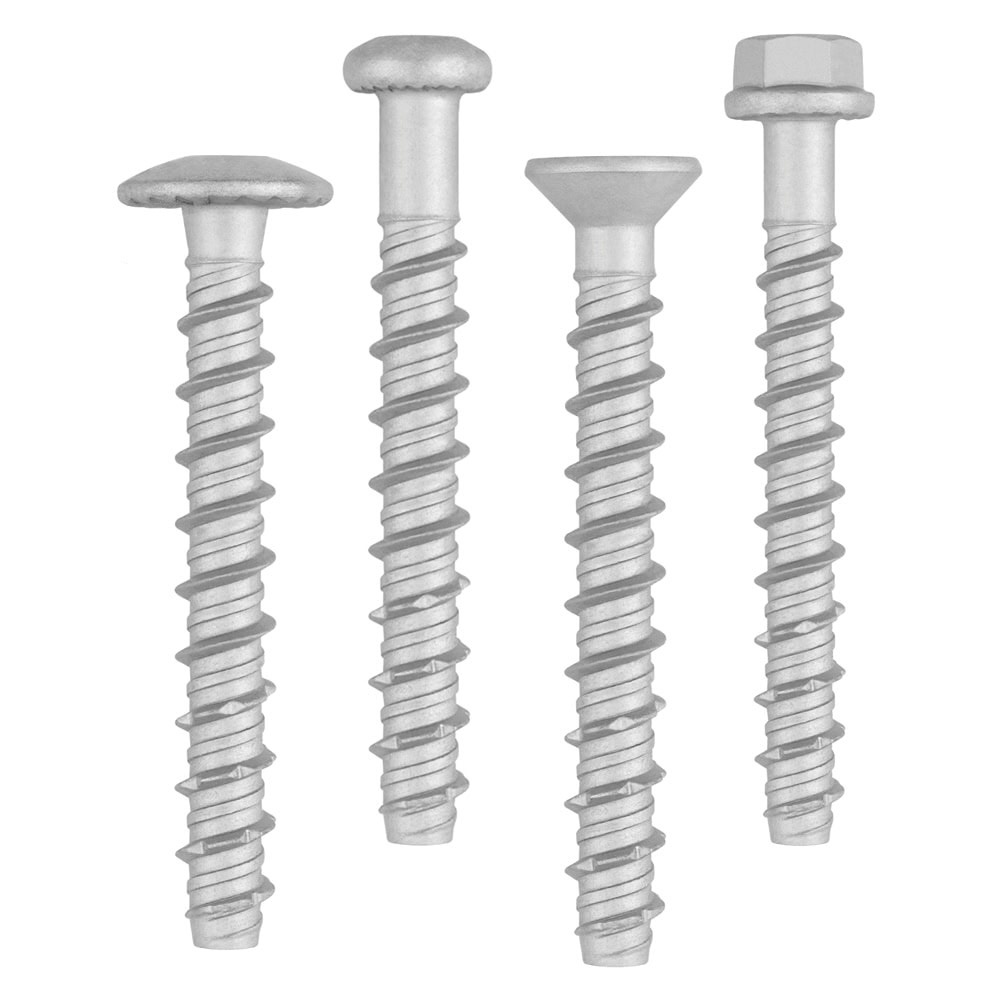
The largest size range is currently available in the hex-head version.
This is the most common industrial variant:
- – quick to install,
- – can be tightened with a large torque,
- – and is well suited to brackets, steel structures or mechanical services fixings.
But other variants exist as well:
Countersunk head version
For places where a flat surface is required.
Dome head version
For a larger bearing surface and for special installation situations.
Flat domed head version
For more aesthetic or special clamping requirements.
“ETA Option 1” — and why is this important?
ETA is not a marketing term.
The ETA (European Technical Assessment) is a European technical qualification system.
The Option 1 category is one of the most serious qualifications for concrete fixings.
This means, among other things, that the product:
- – has been tested in cracked concrete as well,
- – is qualified for specified loads,
- – and has a serious documentation background.
In a great many projects today it is no longer enough that “this will definitely hold”.
The documentation is often just as important as the fastener itself.
What documentation is available?
For the various concrete screw versions the following may be available:
- ETA documentation
- CE conformity
- technical data sheet
- installation instructions
- load tables
- manufacturer recommendations
- for certain types, seismic qualification as well

Choosing the right size is more important than we would think
One typical error with concrete screws is the wrong choice of size: many people simply choose too short a screw.
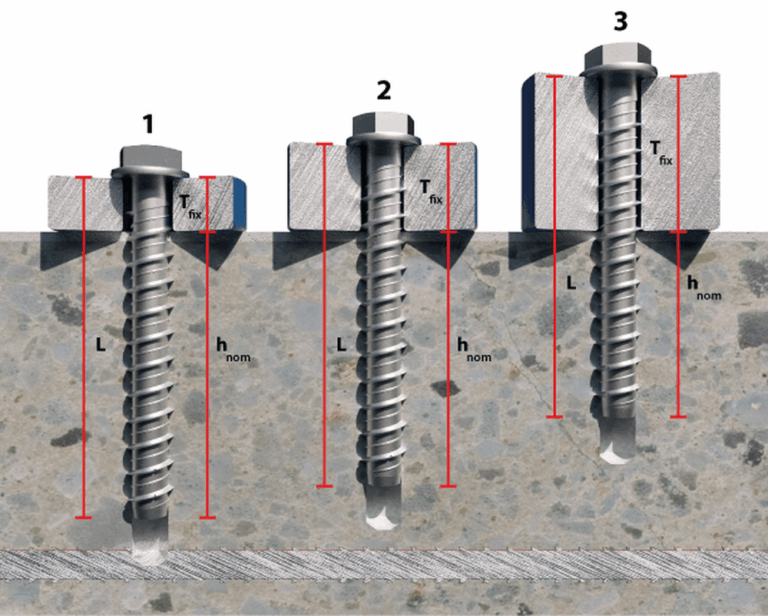
The basis for determining the necessary minimum length:
L ≥ tfix + hnom
where:
- L = the total length of the concrete screw
- tfix = the thickness of the element to be fixed
- hnom = the required embedment depth
That is: the screw not only has to reach through the element to be fixed, but also has to grip into the concrete to an appropriate depth.
A small detail that professionals appreciate
The role of the serration under the head is spoken about more rarely, though it is a very useful detail.
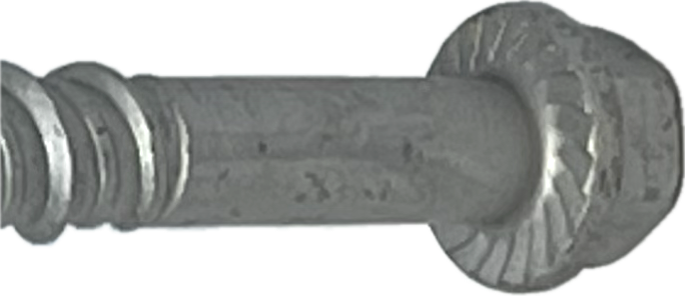
This helps:
- to prevent the workpiece from turning,
- to reduce the chance of loosening,
- and to improve the stability of the joint.
It is typically a detail that few notice at first — in the longer term, however, it counts for a lot.
Types, sizes and selection criteria
Concrete screws are available with various:
- head shapes,
- diameters,
- lengths,
- and differing embedment parameters.
In choosing the appropriate type, an important consideration is:
- the base material,
- the load,
- the environmental effect,
- the edge distance,
- and the design of the structure used.
The concrete screw is no longer a special rarity today, but increasingly a fundamental industrial fixing solution.
With the ATLANTIS-coated concrete screws of INDEX we place a quickly installable, strong, documented and well-thought-out fixing solution in the hands of contractors.
Call our sales colleagues now on +361-453-7060, and gain positive experience from using them yourself!

Leave a Reply