
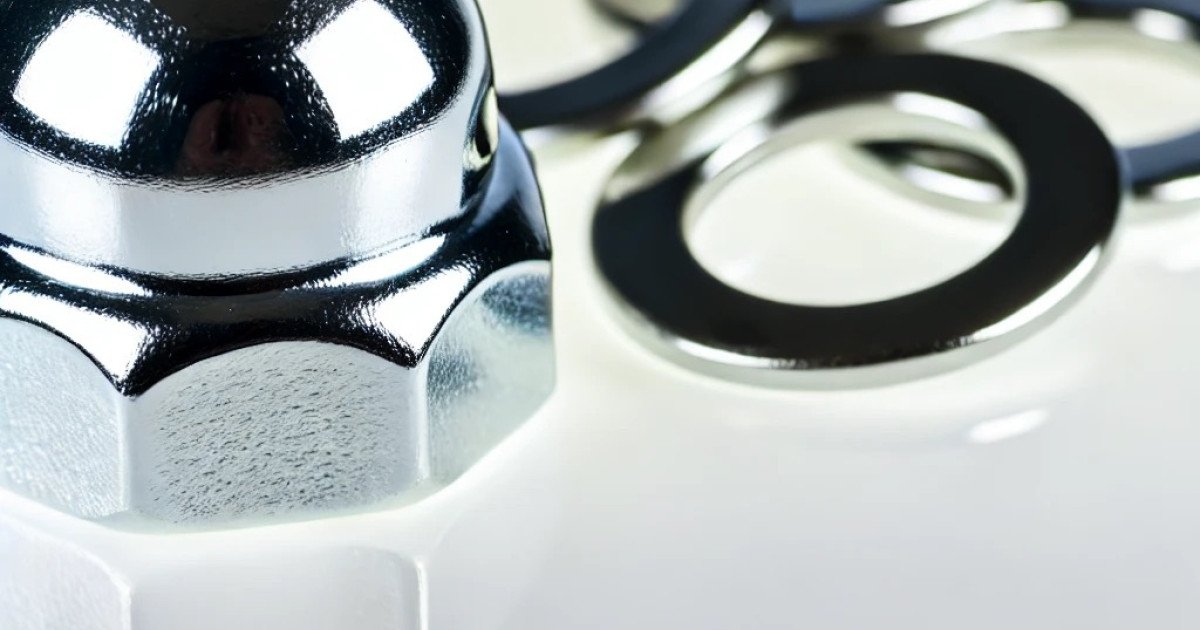
We use bolted joints to assemble our parts because we want to put things together in such a way that they are stable, yet can still be conveniently taken apart later. What we very much do not like, however, is that whatever can be taken apart may — from the vibration that goes with use — even fall on us; so we need to secure our releasable joints. For this reason we use various clever locking elements, which we try to present to you here, without any claim to completeness:
|
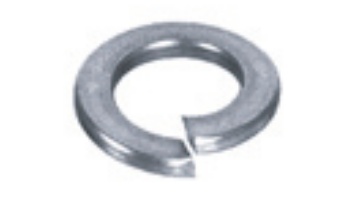
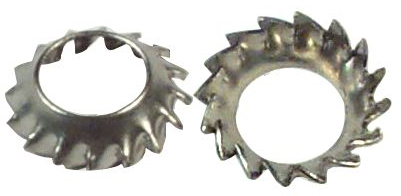
Spring washers: The cheapest, but not the most effective way of securing a bolted joint is the use of the various spring washers. The simplest version is the split ring made of spring steel, which is compressed when the nut is tightened, but because of its material it resists compression and at one point, at its split, pushes the nut back in the direction opposite to tightening. Thread presses against thread, and the friction that arises brakes the movement, so the nut does not shake loose so easily and quickly; One widespread version of spring washers is the nosed spring washer (DIN 127B), which with its bent-out “little noses” bites into both the nut and the surface, and prevents them from turning, quasi as a wedge. In fact we can regard toothed washers (DIN 6797A/I, DIN 6798A/I) as spring washers too; these are likewise made of spring steel, but unlike simple spring washers they apply the braking force not at a single point but over 360°. Toothed washers exist with internal and external, fine and coarse teeth, and even for countersunk head screws (DIN 6798V), but the force distribution of each is different. Here we should also mention the wavy spring washers (DIN 137 A/B), usually made of thinner material, which do not bite into either surface but instead press the thread profiles against each other and brake their movement. Whether we apply the braking force concentrated at one point or distributed over several, on the outer or on the inner diameter – this is in every case a matter of judgement, but in every case the good choice is the one which, adapted to the given conditions, best prevents loosening. |
|
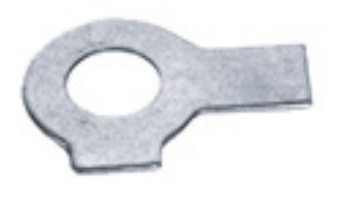
Two-tab locking plate (DIN 463): Near flanges and projections we can use, for example, a two-tab locking plate against the nut shaking loose; its longer tab must be bent onto the flange and the shorter one onto one flat of the nut, so the nut cannot turn. |
|
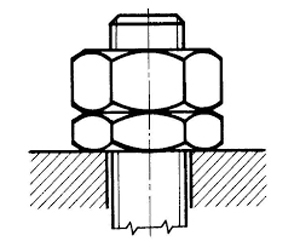
Double-nut locking with a thin nut (DIN 439B): Double-nut locking is a good method when it is not optimal to tighten the screw with too great a force, yet securing it is absolutely necessary. We tighten the main nut to the specified torque, then pull the lock nut firmly onto the main nut. The counteraction arising between the main nut, the lock nut and the thread of the screw prevents loosening. |
|
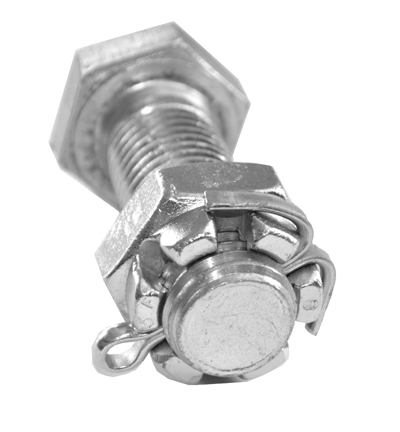
Split-pin (DIN 94) locking: Split-pin locking was widespread earlier, but by now it is a somewhat old-fashioned method. The split pin is made of half-round steel, and one of its legs is left longer than the other so that it can be opened out easily. In this case the nut is a castle nut (DIN 935 tall and DIN 937 low version); after it is tightened, the bolt is drilled through between the teeth of its crown, the split pin is threaded through there, and then its two ends are bent apart. Its disadvantage is that the drilling requires extra work. If there is no castle nut, in the last resort a normal nut will do. |
|
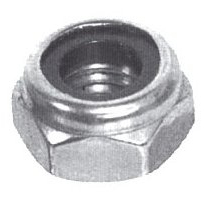
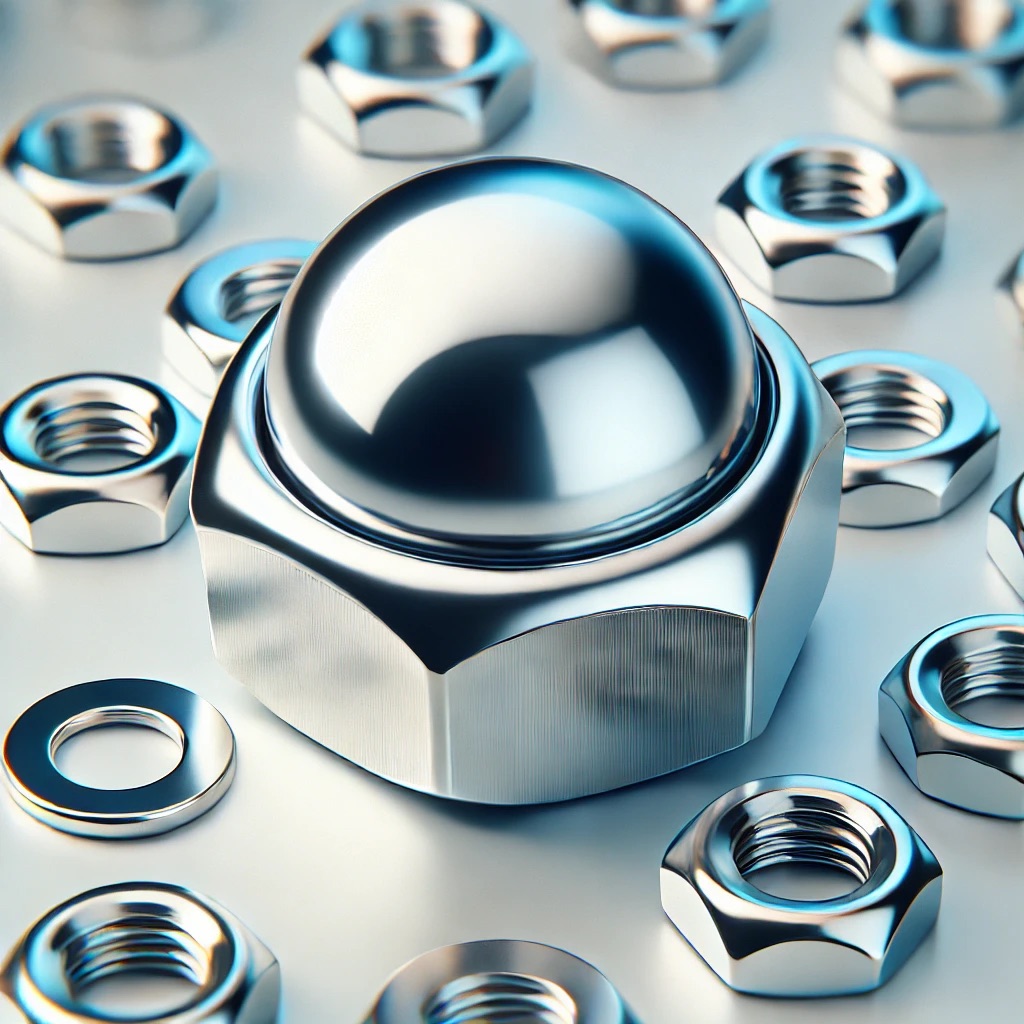
Self-locking (or self-securing) nuts: The most widespread are the plastic-insert self-locking nuts (DIN 982 tall and DIN 985 low version), in which a threadless plastic insert ring is fixed, secured against rotation, at the exit point of the nut’s thread. When the screw is tightened, the plastic conforms tightly to the screw thread, preventing any further movement of it. Did you know that a self-locking nut is also available in a closed version (DIN 986)? One disadvantage of the plastic-insert method is that it cannot be used on parts exposed to high temperatures. The solution to this problem, however, may be the “all-metal” self-locking nut (DIN 980), whose exit side is distorted during manufacture with a pressing tool, but only so much that its thread presses tightly onto the thread of the screw passing through and grips it firmly.Few people know it, but the lock nut bent from spring steel sheet (DIN 7967) also provides effective protection against loosening; it must be turned up flat after the nut to be secured and pulled on so that, through the bending and wedging of the edges of the sheet, it holds the nut in place hard and almost bombproof. If you do not trust it, consider that the Eiffel Tower, which 3 million people a year go up, was assembled with these too! |
In our next article we give a concise but, we hope, useful overview of washers.
Leave a Reply