
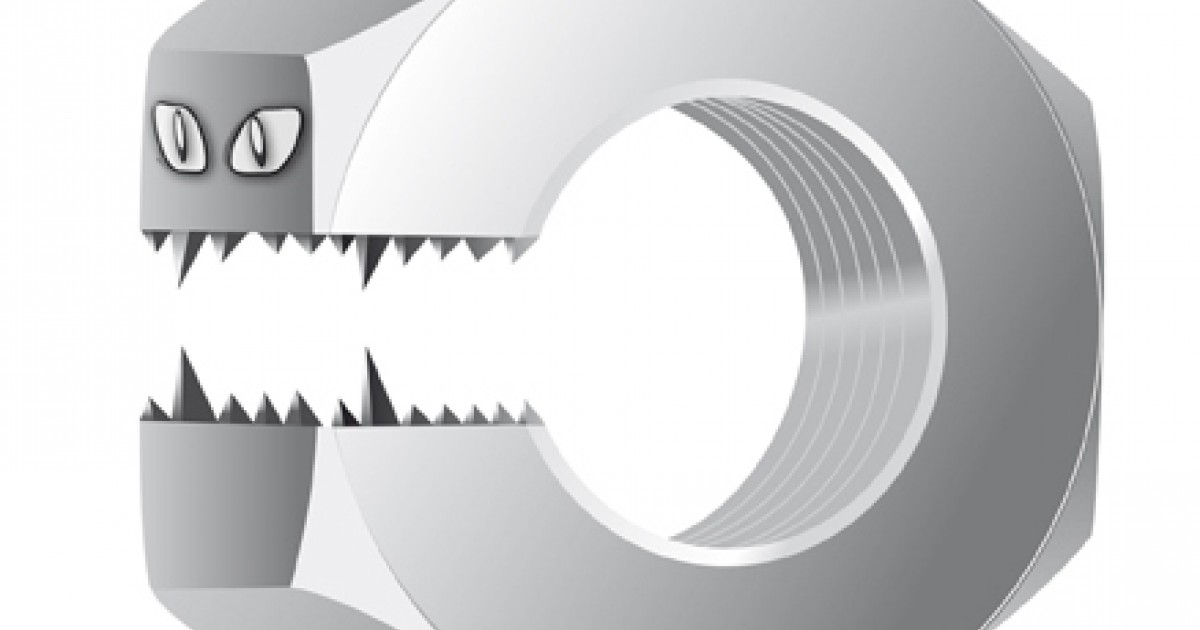
With NONOX stainless steel screw joints, galling of rough surfaces can still cause problems even today.
01The condition of the thread surface
It is not uncommon for the phenomenon to be assumed to be caused by corrosion; in contrast, other triggering causes usually lie in the background, such as coarse thread machining or other surface damage. If, for example, we examine threads work-hardened by rolling under a microscope, we often see cracked, scaly surfaces. The threads themselves are rough and cracked, which provides an increased surface for corrosion to attack.
This can arise if the hardness of the base material is too great, or if unsuitable rolling tools are used for thread rolling, but incorrect tools used for thread turning can equally cause the thread surface to be uneven. These can of course be prevented by using well-chosen tools suitable for machining austenitic NONOX stainless steels.
02The hardness difference between the screw and the nut
Another well-known cause of galling in screw joints is an insufficient hardness difference between the screw and the nut. As we know, austenitic steels harden a great deal during cold forming, which means that the outer layers of the base material’s surface must be carefully taken into account before we manufacture a screw from it.
There must be an appropriate difference between the hardness of the screw and the nut. As a rule, the screw’s base material should have the greater strength and surface hardness, while for the nut it is advisable to choose one that is at least one strength class weaker. Where we pair materials of identical grade, there we either take the stated strength values into account, or, in the case of rolled threads, we must reckon with the work hardening arising during machining.
If we use austenitic NONOX stainless steels but in different grades, we must not forget that the strengths of the base materials are not necessarily identical. For example, the basic strength of material 1.4404 in the quenched and tempered condition is much lower than that of material 1.4529 in the same condition. In case of doubt it is worth starting from the base material’s strength value before we begin manufacturing screws. For our final certainty, let us also carry out an HV 10 indentation hardness test on the material’s surface!
In order to avoid galling of NONOX stainless and acid-resistant fasteners, the hardness difference between the two contacting surfaces must be at least 50 HV.
Ralf L.
Product Management
Translated by: Szöllősy András

Leave a Reply