
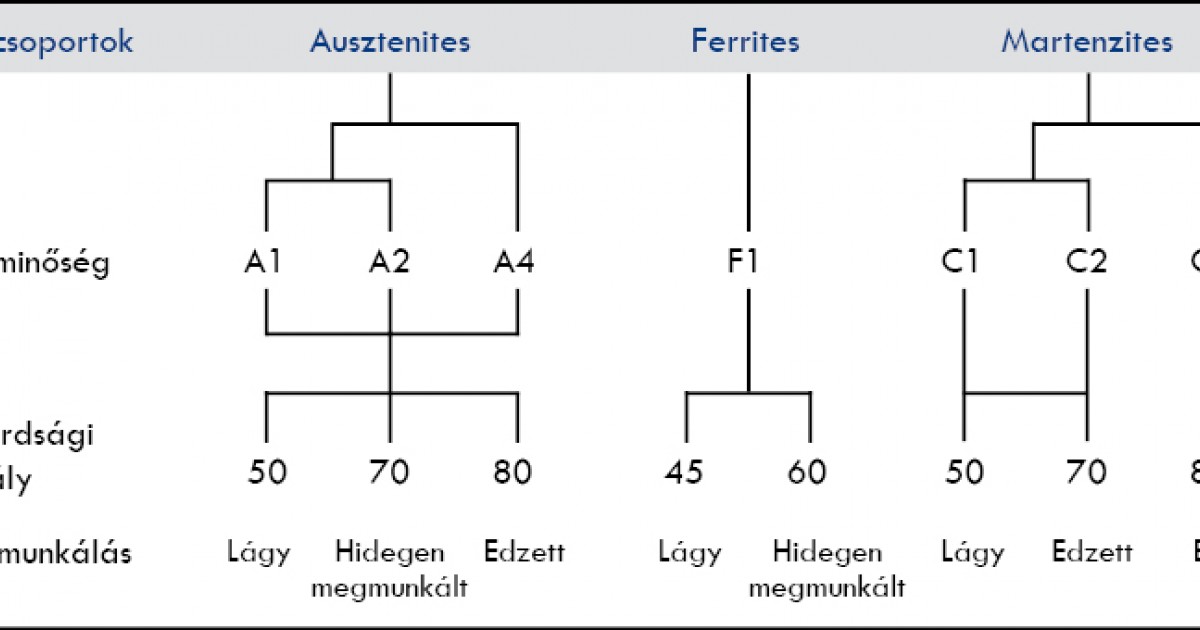
Extract from standard DIN EN ISO 3506.
Steel groups and strength classes are designated by a sequence of letters and numbers consisting of 4 characters:
The letters denote the general classification of the steel groups:
- A =austenitic steels
- C =martensitic steels
- F =ferritic steels
The first digit after the letter denotes the metal alloying elements as follows:
- 1 –Chromium-nickel alloying elements, but a high sulphur and phosphorus content; because of this, however, it is easy to machine, difficult to weld, and its corrosion resistance decreases during machining.
- 2 –Chromium-nickel alloying elements. A widely used type of stainless steel.
- 3 –Chromium-nickel-titanium alloying elements. Stabilised stainless steel. For use at high temperatures.
- 4 –Chromium-nickel-molybdenum alloying elements. Acid-resistant steel.
- 5 –Chromium-nickel-molybdenum-titanium alloying elements. Stabilised acid-resistant steel. For use at high temperatures.
The last two digits denote the strength class
Let’s look at two examples!
- 1
A2-70= austenitic steel, with chromium-nickel alloying elements, cold worked, tensile strength at least 700 N/mm2 - 2
C4-70= martensitic chromium steel, hardened, tensile strength at least 700 N/mm2.
ISO – Steel groups – Designations of stainless and acid-resistant steels
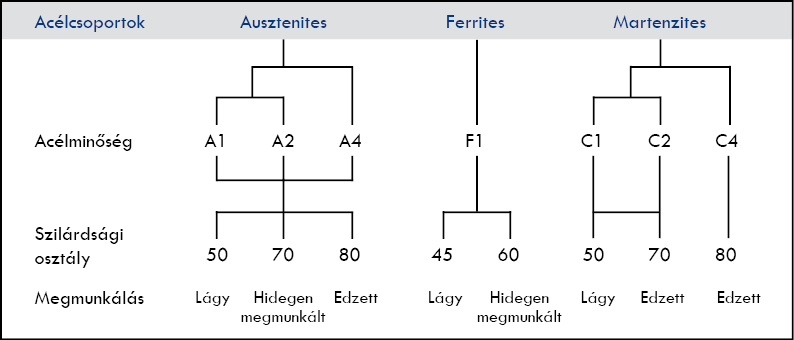
* The designation of stainless steels with a low carbon content (below 0.03%) may be supplemented with the letter L. For example: A4L-80
A continuation of this article follows, in which we give the material composition of the alloys.


Leave a Reply