
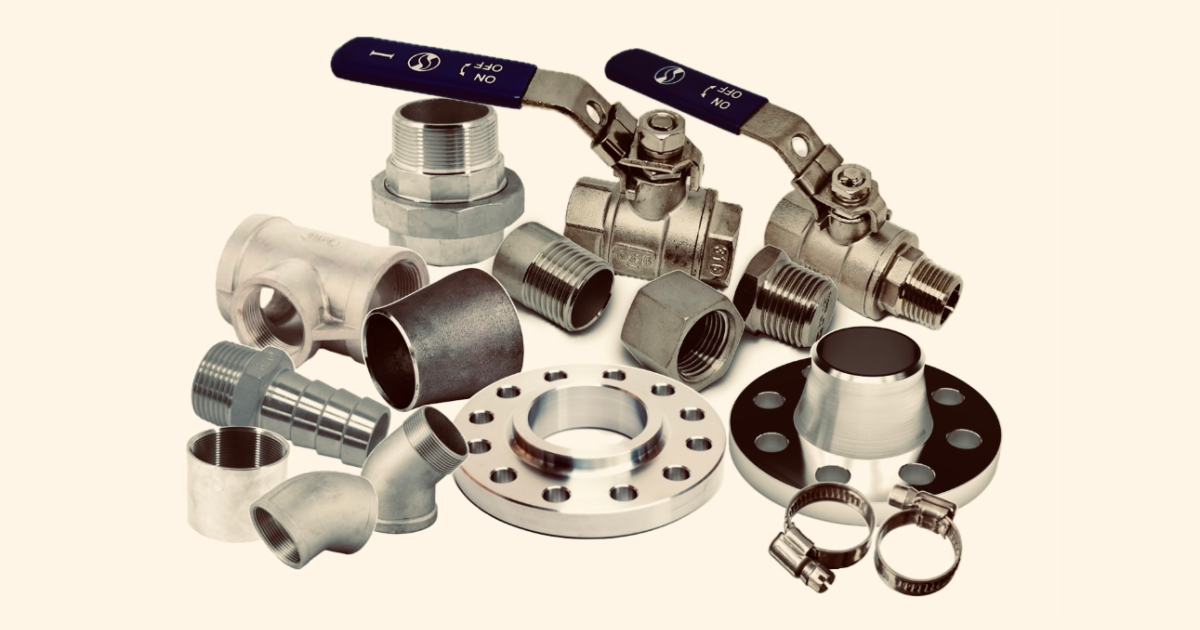
Let us think about what technical solutions help us in our everyday lives. How does water flow from the tap? How can we cook with gas? Yet these form organic parts of our lives and our needs. If we stop to think, the pipeline network criss-crossing the walls and the depths of the earth comes to mind, carrying the materials we need to the place of use. The elements of this pipe network are what we call pipe fittings, whose various units perform differing functions. The range of applications is wide, extending from the domestic one already mentioned to industrial use that imposes special requirements. The materials to be conveyed occur in liquid or gaseous form, and the system to be built must be matched to these. The need for fittings is obvious, since we would like the pipeline carrying the material important to us to “turn the corner”, or to be able to shut it off once we have had enough of a good thing. For connecting the elements we also find several solutions, but a secure joint is characteristic of all of them. As regards their material, they match the quality requirements: they can be made of cast iron, stainless steel (A2), or even acid- and alkali-resistant steel (A4). As a result of the surface treatment they gleam metallically, thus creating an elegant effect. As regards the dimensions important to the user, they can be metric (metre) or Anglo-Saxon (inch) based.
01Fittings
Since our pipeline does not run straight towards its destination, we need a few modifying elements. The necessary branching, reduction and enlargement can be realised with the aid of fitting pieces, whose material matches the material of the other pieces of the pipe network.
Elbows – fitting elements
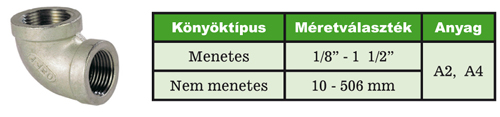
First let us look at the elbow fitting, which makes a change of direction possible to the necessary extent (45º–90º). They generally occur in steel, in welded, drawn or cast versions, but they can also be made of plastic. Elbows with threaded ends belong in a separate group; their easy installation simplifies the build. During installation an important question is whether the connecting threads are located on the outside or the inside of the fitting, because both a male and a female thread are possible at the two end points. They are also made in weldable versions, so we can form the connection ourselves according to our own needs.
T fitting elements
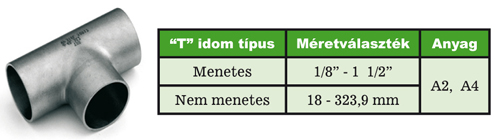
There may be a case where our pipeline has to branch in several directions; then we can apply the “T” fitting, named after its shape, with which we can easily realise this. These have almost the same properties as the elbow fittings mentioned, with the difference that here the two outlets always enclose 90º with each other.
02Pipe joints
But what happens if we want to connect two pipes in a straight line?
Union fittings
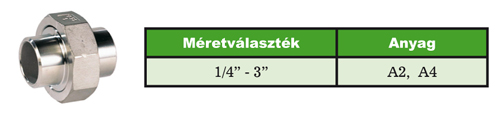
A solution for this is offered by the so-called union, which is able to connect two threaded-end pipe pieces securely. In this design we screw onto the threaded pipe ends extension pieces that can be clamped together with the aid of a pipe nut (union nut). Here too we must pay attention to the end forms! It is available in weldable, *KK, BB and KB forms as well.
Threaded extension pipes
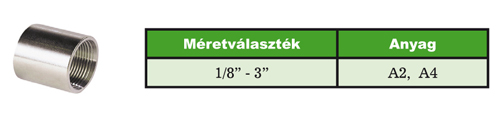
A simple solution, similar to the previous one, is to screw onto the threaded pipe ends a piece of pipe fitted with a simple female thread, the socket, which ensures the necessary connection.
Extension flanges
A further possible joining method is the use of the hexagonal nipple, on which the joint comes about by connecting the threaded parts found at the two ends with a hexagonal nut. Let us not think that we can achieve our goal only with these means; a number of other solutions exist!
Quick couplings
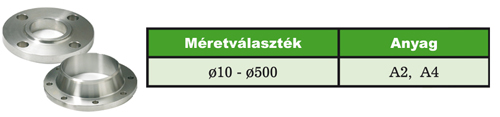
A widespread method is the use of the flange, a disc fitted with holes on a given diameter and fixed to the elements to be joined by some rigid connection. The flanges placed on the ends of the pipes are clamped together with screws, enclosing a sealing ring between them. The design of flanges also comes in several kinds: it can be simple flat, it can be a welding-neck type, which provides a larger connecting surface with the pipe, and there is a bolted version too. Their fixing generally takes place by welding, and since they are standard elements they do not have to be dimensioned for strength.
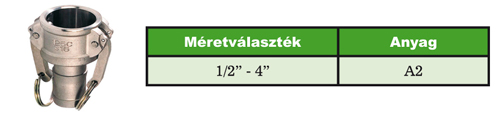
But people always strive for convenience and steer developments in this direction too, so it is no wonder that quick couplings were also developed, which create the connection in a moment. Such are the Kamlok quick couplings, which are essentially unions in which the joint comes about by clamping down the levers found on them instead of by a screwed connection. At the end of the many joints we also have to be able to close off our system somehow, if we do not want our conveyed material to flow out into the open without end. The question is whether we want to realise this closure only temporarily or permanently. If we want a permanent closure, we must apply a threaded end cap, which is found in various forms. It can be a female-threaded cap, or a male-threaded hexagonal, square or hex-socket plug.
03Pipe fittings
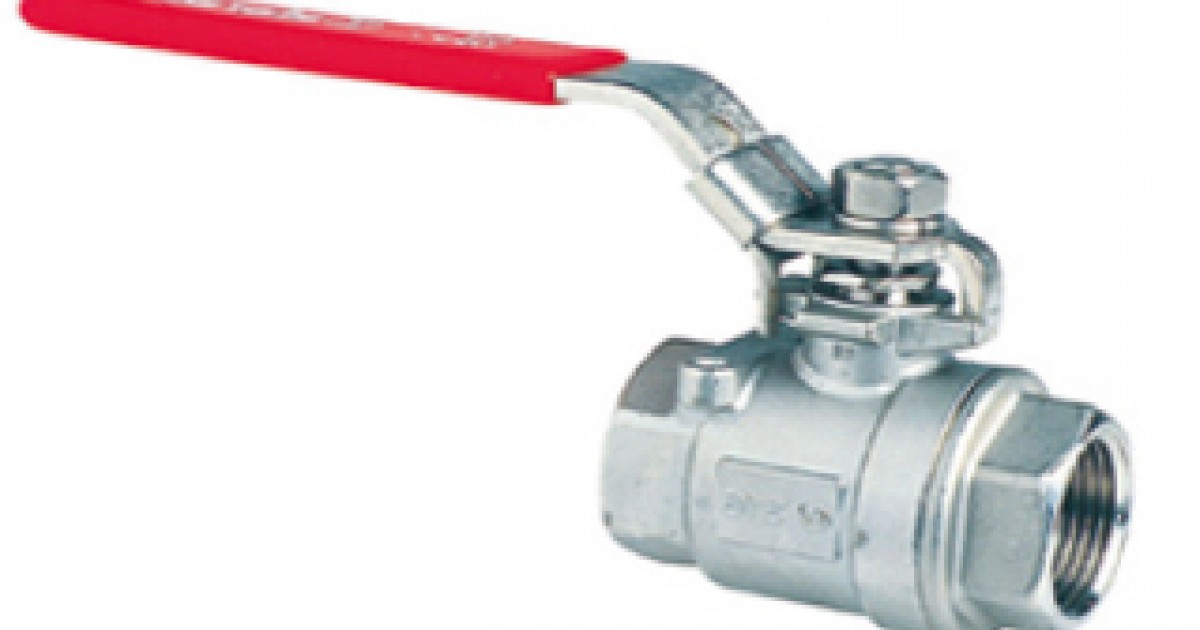
In most cases, however, we want to regulate the quantity of the flowing medium — in plain language, we want to open and close the system. In such cases the well-known taps are useful, which come in several types according to their operating principle. The most widespread is the ball valve, also known as the spherical tap, which its simple design and operability make attractive to users. With its help we can easily change the quantity of the material flowing through by turning the lever found on the structure. The butterfly valve works on a different principle, where the quantity of material can be regulated by turning a closing disc positioned perpendicular to the flow. With this solution the advantages are the small space requirement and weight and the easy and rapid operation, but the disadvantage is that in the open state the flow cross-section is somewhat smaller.
04Questions and answers
- Can we combine the fitting elements and pipe fittings we want to use as we please?No — alongside matching the connecting dimensions we must also pay attention to the selection of the materials; generally they should be made of the same material. In this way so-called contact corrosion can be avoided, which metals with different electrochemical potentials suffer if they convey an electrically conductive medium. An example of this is the stainless steel–steel pairing; in such a case “foreign” rust forms. The stainless–stainless steel and the acid-resistant–stainless steel pairing are recommended.
- Why is it necessary to pay attention to the permitted pressure and temperature values on the elements?This has both strength-related and operational reasons. The finished elements are certified by the manufacturers for a given pressure, at or below which value they operate safely without deformation, cracking or fracture occurring. This is interesting mainly with the seals applied, since their strength characteristics do not even come close to those of steel. The same applies to thermal loading, but here the chemical (corrosion) and physical (thermal expansion, softening) behaviour of the materials must also be reckoned with.
05Ball valves
Ball valves
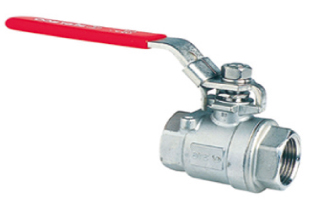
At first glance it may seem a complicated structure, but after a little investigation we may realise how simple its “soul” is. Its function is clear: opening and closing, regulation. The realisation is not complicated either: take a section of pipe (in two parts for the sake of assembly), put into it a ball fitted with a cavity of a diameter matching the inner diameter of the pipe, make the ball rotatable and seal it. The ball valve is ready! Of course, as in everything, the devil lives in the details here too, so let us look inside a little. The closing ball has a polished surface, and for protection its surface is covered with a chromium layer; its rotation can take place in several ways, but precise sealing is important. As sealing elements, rings and shaped elements generally made of PTFE (Teflon) material are used throughout the whole structure. The material of the body can be carbon steel, stainless steel, acid-resistant steel, or brass according to needs. From the point of view of design it can be a welded structure, or one made of two or three parts clamped together by screws. With assembled ball valves the advantage is that they can be taken apart and cleaned. The external connection can be realised with a weldable extension piece, a female thread, or a flange. There also exist types fitted with a mounting top flange located under the hand lever that assists fixing. An important consideration is the “smoothest” possible onward passage of the flowing medium; this is helped by the full bore cross-section, which we can achieve by turning the lever in the appropriate direction. Among its advantageous properties, the low flow loss, low resistance coefficient and low opening-closing torque requirement stand out.
06A point of interest
In the description of flanges one special kind was left out, the loose flange. With this joint type the inner diameter of the flange is larger than usual, so a collar ring is customarily welded onto the pipe so that the element can butt against it. In such cases we use stud bolts with a flexible shank to connect the flanges, fixed with a nut at both ends. This type can be useful if the system operates at high pressure or at high temperature. In that case it has the possibility of taking up the elongations because of the greater flexibility of the joint, and the flange and the pipe can undergo deformation independently of each other.
Leave a Reply