
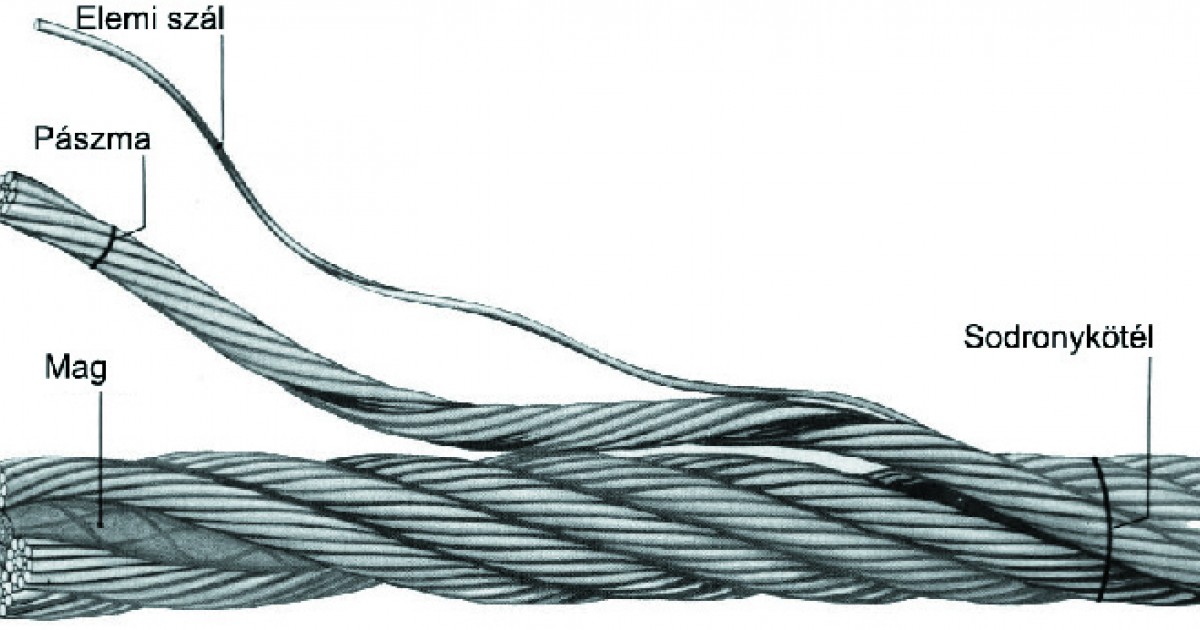
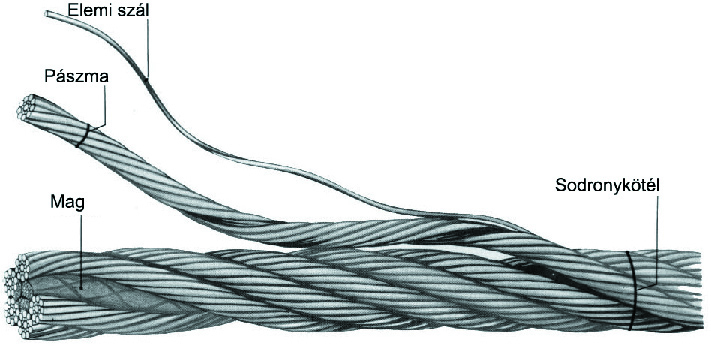
A strand made from the wires of steel or another metal. It consists of high-strength, thin elementary wires. The elementary wires are manufactured from rolled wire of 10–12 mm diameter by cold working (drawing through a roller), so their surface becomes harder and their tensile strength greater. Steel wire rope is produced on a stranding machine. By varying the technique of stranding and the cross-section of the wire rope, many types of differing construction and properties have developed over the course of time.
In which fields are wire ropes primarily used?
- Wire ropes used in forestry,
- Wire ropes used in quarries,
- Wire ropes for shipping,
- Wire ropes of working machines,
- Lift wire ropes,
- Fishing wire ropes,
- In lifting technology,
- etc.
Its kinds according to the technology of stranding:
Single-stranded rope, (e.g.: DIN-3052, 3053) when the wires or elementary strands are arranged in one or more layers around a steel core or hemp insert. The stranded layers may be of the same, or of alternately opposite, lay direction.

Double-stranded rope. (E.g.: DIN- 3054, 3055, 3060). Its elementary wires are first stranded into a strand, and then the strands into a rope. The strand is a bundle of wires in which the wires are arranged in one or more rows. The double-stranded rope may be:
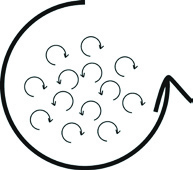
Lang’s lay, if the lay of the strand in the rope and the lay of the wire in the strand are in the same direction. Such a rope is flexible, but casts strongly, is prone to loop formation and rotates to a great extent under load. It is rather usable as a rope both ends of which are firmly secured.
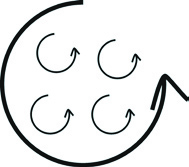
Regular lay, if the lay of the strand in the rope and the lay of the wire in the strand are in opposite directions. Such a rope casts only to a small extent, rotates less and is stiffer. On cranes, regular-lay rope is used almost without exception.
Spiral-strand (non-rotating) rope, in which the layers stranded one above another from the strands are alternately of regular and Lang’s lay.
Non-unwinding (non-unravelling) rope; this is stranded in such a way that the elementary wires are preformed into a spiral shape cold and arranged into a strand on a stranding machine. The wire ends of such a rope do not spring out in the event of a wire break.
Flat rope (band rope); it is produced by stitching four-strand steel ropes side by side.

Locked coil rope, if the outer layer of the single-stranded rope is made from Z-shaped profile wires or elementary wires of trapezoidal cross-section; stranded into a layer on the outer surface of the rope, these form a completely closed, smooth cylindrical surface.

Seale rope: in its strands the inner layer is stranded from thinner and the outer ones from thicker steel wires. The wires of the outer row always remain in the same position relative to the wires of the row beneath them along the whole length of the rope, and the elementary wires of the strands do not cross one another. Thus there are no highly stressed points of point-like bearing, as there are, for example, with regular-lay rope.
The Warrington rope is of similar lay to the Seale rope, but in its strands the thinner and the thicker elementary wires lie side by side.
According to its loading or purpose, the wire rope may be:
- Running rope, which during operation, passing over the guide elements, suffers more considerable bending stress because of the flexing. Crane, lift, mine-hoisting and winch ropes are such. As running ropes, regular-lay ropes are generally used, because the securing of the individual elementary wires is denser, the rope is stiffer and it is less prone to unstranding. On cranes where the load hangs on a single rope, casting and rotation cannot be permitted, and spiral-strand rope is used.
- Standing rope, on which a resting or moved load hangs, and which is mainly loaded in tension, e.g. the standing ropes of ropeways, cable cranes and bridges, the guy ropes of masts. The two ends of standing ropes are secured, so unstranding is not possible. The guidelines relating to the use, dimensioning, selection and ordering of steel wire ropes are laid down in standards. The standards also contain the standard cross-section and designation of the individual rope constructions. The rope suffers bending when guided (over a sheave) or stored (on a drum), and thus the greater stress arises in the outer elementary wires the smaller the diameter of the sheave or the drum. The standard always gives the diameter of the sheave or the drum in proportion to the rope diameter. The service life of the rope is determined by the stresses and the degree of wear arising during use or operation. The rope must be replaced if the number of its broken wires has exceeded the quantity specified in the standard. It must also be replaced if a cut, kink or loop forms on it.
The production of hand-woven steel rope is linked to the name of mining councillor Albert, who patented his process in 1834. Steel rope was first used in the Francis Augustus shaft at Clausthal in the Harz Mountains. Not long afterwards, in 1837, steel rope was first woven by machine in Selmecbánya, on a Viennese-made Wurm hemp-rope weaving machine. Steel rope, as a flexible and high-load-capacity traction element that is moreover light and suitable for high-speed movement, practically revolutionised the mine hoisting and lifting-machine manufacture of the period. Since then its production has undergone enormous development, and its use extends to almost every field of conveying.

Leave a Reply