
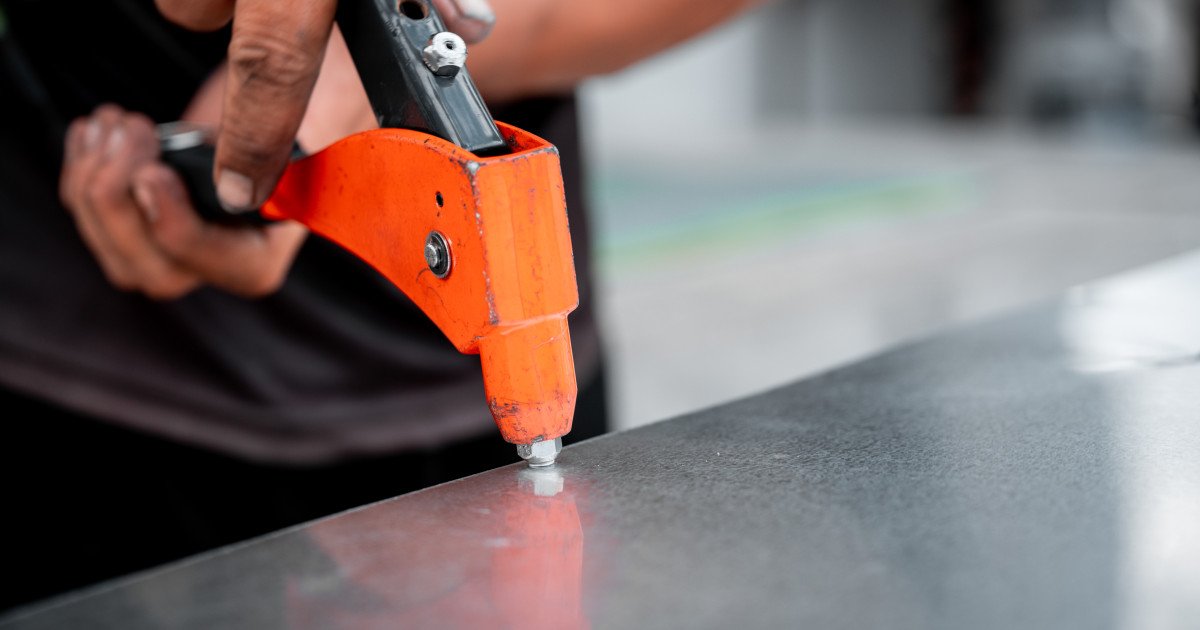
Where would we most likely need “some sort of pop rivets” if we wanted a quick and neat solution, and screwing, welding or conventional riveting were out of the question?

The origin and the name
Blind rivets were developed primarily for fixing sheets to one another, back when humankind was just trying out its wings… This was a pioneering technology with which, in those days, they could produce quickly and in large quantities… It almost goes without saying that the defence industry, and within it aircraft manufacturing, was the field where this was needed most. Who would have thought that the “pop rivet” (“POP rivets”) comes from a brand name, registered from those very times onwards by the English company Tucker? Had it not become widely known under this name, we would now call it a “pull rivet”, or we would have adopted the term blind rivet (blind rivets) from English. The professional name for pop riveting, incidentally, is “pull-stem blind riveting”.
The idea
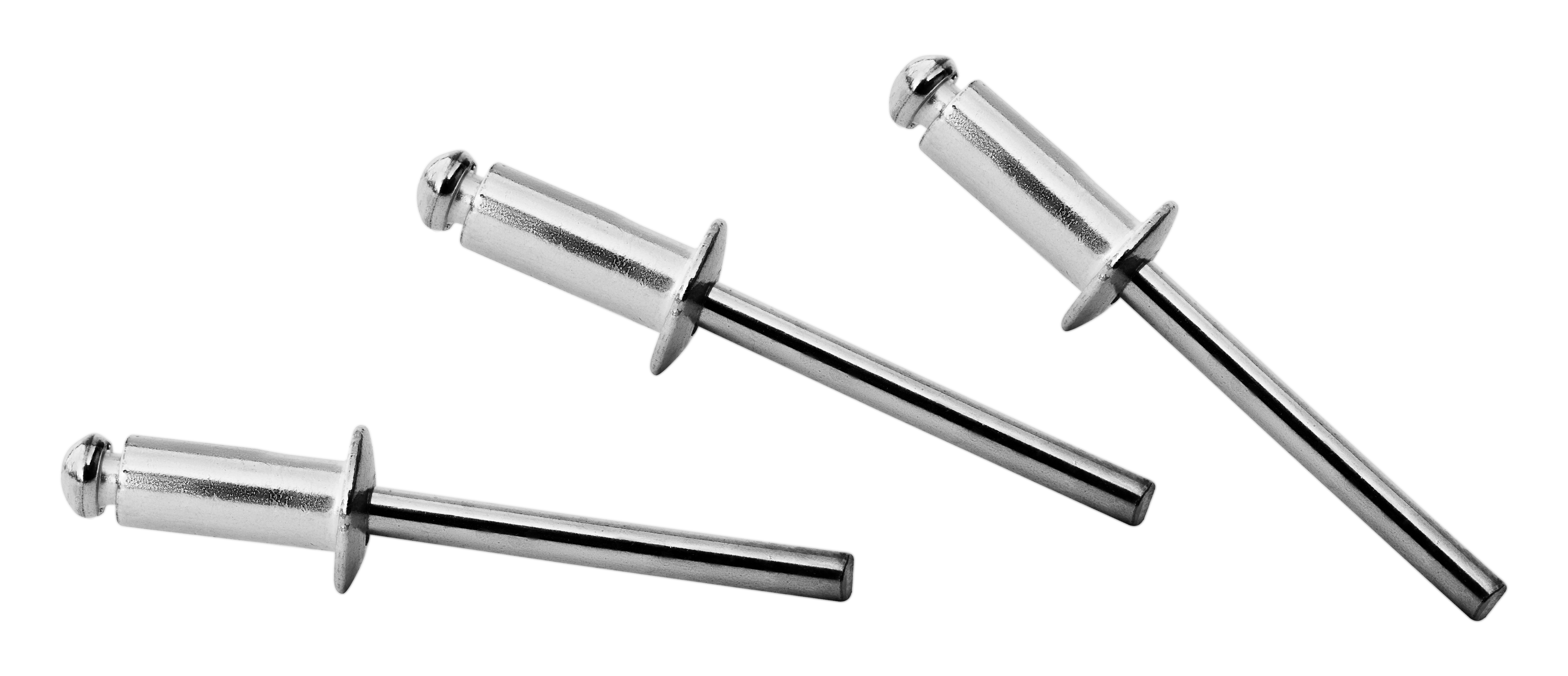
The idea is simple: let us place a thin-walled, flanged metal tube into the hole, and try to pull through it, from the inside outwards, a mandrel resembling a “cartwright’s nail”, so that the tube, buckling up from the inside, is upset into the hole and binds in it sufficiently. If we thin the mandrel down in advance at the right place, it breaks off when its head, approaching the hole, binds in the tube. Under the appropriate force the head of the mandrel remains inside the tube with a short piece of stem, but the broken-off part falls out, and so the swollen tube fixes the sheets firmly to one another. The rigidity of the joint is provided by the retained head and stem piece together, and this also increases resistance to shear forces, which occur frequently with sheets.

How it spread
That is how it all started, and by today this clever invention has spread everywhere in the world. Clean, fast, workable from one side, involving neither dangerous heat nor deforming force on the structure, cheap, and if necessary it can be dismantled and rebuilt… Well, it is worth taking care that the torn-off mandrels do not drop in among moving parts, and if rust is not a consideration, then we can even take off. The technology and the use of the name “pop rivet” have spread throughout the world, and today it is available in all sorts of sizes and material grades, together with professional riveting tools. The rivet itself is typically no longer made from tube but from wire by cold forming (1), where the machine forms the cylindrical shape, and the tube-like hole in it, with rapid, powerful blows. A great advantage of these rivets is that they are not prone to cracking, unlike the pop rivets formerly made from conventional tube.
Hole, size, versions
On the workpiece the hole can be drilled or punched (2); the point is that the tube should slide in easily, but should not be too wide either, so that the rivet is upset when pulled. As a general rule, the hole should be about 0,1 mm larger than the diameter of the rivet. To determine the length of the rivet it is best to check the rivet manufacturer’s instructions. The many individual requirements were not an obstacle but a challenge to its spread, and so there came countersunk, domed, small-, medium- and large-headed, splitting and crimped versions, in aluminium, steel, copper and inox, natural and painted in RAL (3) colours. Outdoors and in areas to be sealed from moisture it is of course worth choosing a stainless material grade, such as the aluminium rivet with an inox mandrel, since a mandrel that has snapped off leaves an ugly rust stain if its material is not stainless; but the most professional are of course the much higher-strength NONOX A2 stainless or A4 acid-resistant versions, which can be obtained quickly and at favourable prices from Menet-Trend Kft. Let me mention that these NONOX A2 and A4 blind rivets can also be ordered in a closed-end design, which further prevents the passage of liquid and vapour.
It costs you just one phone call, and we will answer every question; if you have no questions, then you can place your order right away, and you will not be disappointed:
+36-1-453-7060Glossary
Our blind rivet range is available at the link below
Blind rivets in the webshop
Leave a Reply