

What can the wind do to a roof?
The suction effect of the wind depends on the height of the roof and the pitch of the roof. As the roof pitch decreases and the height increases, the suction effect of the wind grows, and its force can reach 4–5 times the dead weight of the roofing material. The increasingly frequent storm winds easily break up even a roof covered with concrete tiles. With correct execution the problem can be eliminated.
What does the manufacturer recommend?
Manufacturers of concrete tiles generally recommend fixing every second or third tile at a roof pitch of between 40 and 60 degrees, and every single tile above 60 degrees. In the case of ceramic tiles they are more cautious than this, and above 50 degrees they already prescribe the fixing of every tile. It does no harm to take into account, too, that in the case of roofs of lower pitch the suction effect of the wind appears to a heightened degree. Therefore the fixing of the eaves-course, ridge-course and verge tiles, as well as the cut tiles at the valley and the ridge, is important under all circumstances.
What should we fix the tile with?
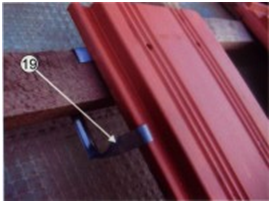
The most commonly used solution is the aluminium storm clip. This generally works excellently; there is only one problem with it, that its price is roughly the same as the price of the tile, so it makes the execution significantly more expensive. As a consequence, contractors like to dispense with its use, which is not a problem either — until the first bigger gusts of wind. The cheapest solution is nailing. Its disadvantage is that it fixes only the upper third of the tile, so the wind is able to move the tile and the nailing loosens. Displacement is less likely if we use a screw instead of nails.
The “tinsmith’s” screw is not only simple and cheap, but at the same time also the most aesthetic solution.
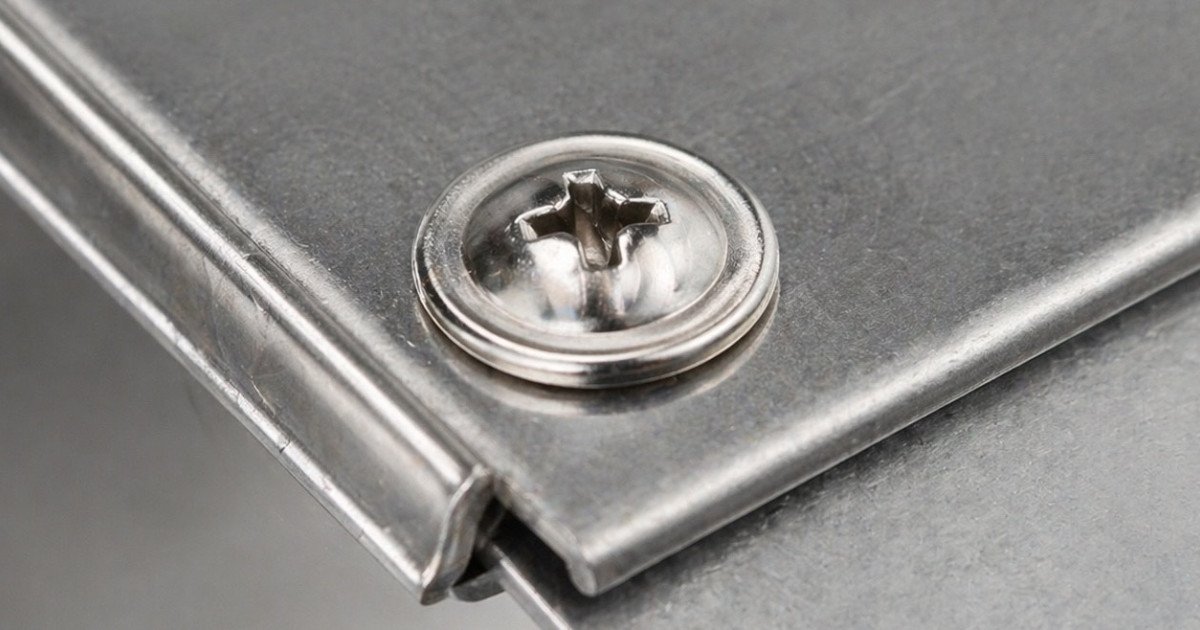
We can use a tinsmith’s screw even at the most sensitive points of the roof. Under the head of the screw there is a downward-facing metal bell filled with waterproofing material. When the screw is driven in, the sealing material flattens and fills every gap, so water cannot get into the structure in the vicinity of the screw. Its use is extremely simple: we simply drill through the tile or sheet metal to be fixed and drive in the screw.
The tinsmith’s screw is especially useful for fixing ridge tiles
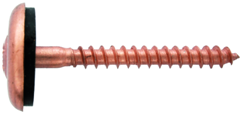
If we drill through the ridge tile at two points and fix it with a tinsmith’s screw, there is no wind that will tear it off. Moreover it is much cheaper than the storm clip used for fixing ridge tiles. (Which likewise has to be fixed to the rafter with two screws.) Use only tinsmith’s screws of impeccable quality! The stress on the roof is very serious. The temperature fluctuation is enormous. It is a damp environment, and in cities an acidic one because of air pollution. Use only stainless screws fitted with EPDM or NEOPRENE sealing — for example NONOX A2 tinsmith’s screws. Even if, for the sake of the aesthetics of the roof, you choose a coated, coppered screw, let the raw material still be stainless! On driving in, the coating may be damaged, and in an acidic environment an unprotected iron screw corrodes with stormy speed. Finally, a few words about EPDM (ethylene propylene terpolymer) and NEOPRENE (chloroprene) sealing. These two rubber-based polymers are heat- and weather-resistant, acid- and alkali-resistant. They withstand UV radiation without damage and retain their flexibility from -60°C to +120°C. NEOPRENE is in addition also flame-resistant.
You can order NONOX A2 tinsmith’s screws without a coating, in the original steel colour, or with a copper coating, with NEOPRENE or EPDM sealing washer, with various washer diameters and screw sizes. The delivery lead time is approx. 3–5 working days, depending on type, size and quantity.

Leave a Reply