
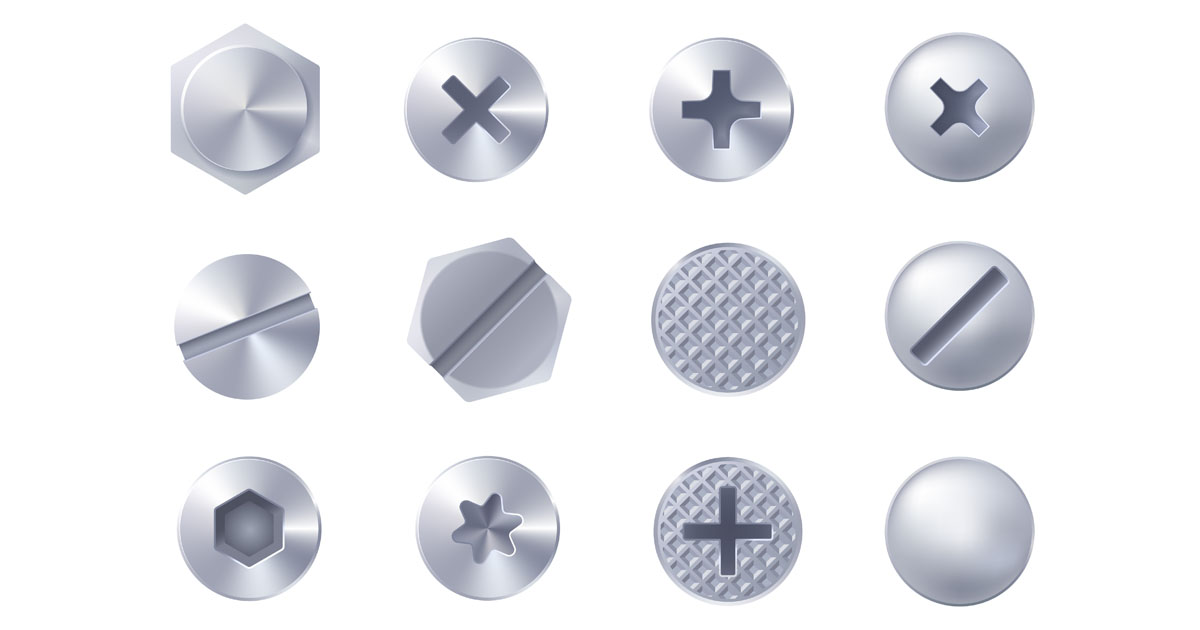
Screws hold together the greater part of the man-made world. The advantage of screwing over other fixings is that it is easy to fit and easy to undo afterwards. The variety of screws is determined by the variety of uses, therefore ever newer types keep appearing and becoming widespread, while others drop out of daily use. We can group the elements of this by now very wide palette in many ways, among other things according to their raw material, the type of their threads or their strength, but the most striking difference of all shows itself in their head design. The screw head ensures the stable fixing of the screw shank in one direction, as well as its axial turning for assembly and disassembly. Various keys are used for fitting, from the simple screwdriver to open-ended spanners, and the heads are accordingly fitted with various drives and/or grooves.
Hex-head bolt
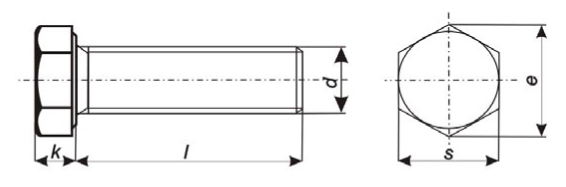
The most widespread type of all. It is characterised by the fact that the screw head has to be accessed from the outside, therefore it is fundamentally applied in places where there is the opportunity for this. Almost every version is available, e.g. wood screw, self-tapping screw, metric and inch (nut-type) versions and many others. Its size range is the largest possible among all screw types; its diameter can extend from 1 mm to as much as 100 mm. For fitting it, an open-ended spanner is generally used, or a ring spanner, which ensures far more perfect force transmission, while the various socket spanners ensure easy and rapid fitting even in tight, hidden places. From the weakest (3.6, 4.6, 4.8, 5.6, 5.8, 6.8*) to the strongest (8.8, 10.9, 12.9*), every version is available, and in terms of material grades everything is available from the most commercial iron to hardened steel, from aluminium to brass, from chemically resistant plastic (PA) to NONOX stainless (A2) or NONOX acid-resistant (A4) steel. Its manufacture is simple, therefore it is cheap, and because of its force transmission properties, which can be called good, it is extremely widespread. A fully threaded and a partially threaded version exist. In the Hungarian Standard the standard number of the fully threaded version is MSZ 2363 and that of the partially threaded one is MSZ 2360, but by now the DIN (German) standard has become the most widespread throughout Europe, so the products also comply with these standards. The number of the fully threaded version is DIN 933, and that of the partially threaded version DIN 931.
Common abbreviations, e.g.: hlf. tm. and hlf. rm. cs.
Cylindrical head hex socket screw
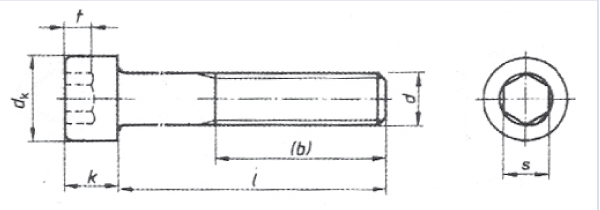
The next most widespread type. It is applied primarily in tight, hard-to-access places, because when fitting there is no need to access the head from the outside, e.g. in machines, vehicles, and when assembling engine covers. There exist handy “L”-shaped and screwdriver-shaped driving tools for it, as well as ones the size of a tiny vitamin capsule, so-called bits. It exists in just as many versions as the hex-head version. In terms of their usability, the most typical are the metric mechanical-engineering types, which can be tightened up paired with a nut, or with a thread cut into the casting. A fully threaded and a partially threaded alternative likewise exists, in accordance with the differing needs of users. The size scale is only a little narrower than that of hex-head bolts. The hexagon socket is slowly beginning to be replaced by a new, modern version ensuring far more effective force transmission, the so-called TORX drive, where the meeting of the tool and the key is realised not at the corner points of the hexagon but over full faces. The standard number of the cylindrical head hex socket screw is DIN 912. Similar hex socket versions are also the low-head, hex socket DIN 6912 and the low-head, small-socket DIN 7984 types. Besides these, countersunk, “D” head and headless hex socket screws also exist (grub screws). This family typically comprises metric versions in Europe, while overseas primarily inch versions are available. We can also come across certain special applications; among these the most typical are cylindrical head hex socket self-tapping screws, which are used mainly for assembling doors and windows.
Common abbreviations, e.g.: bkny cs., (also like this: hf. bkny. cs.; sf. bkny. cs.), Imbusz screw.
Headless screws
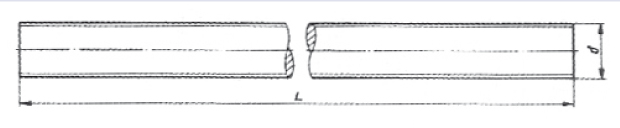
Such are primarily threaded rods, which are 1, 2 and 3 metre screw shanks, without a head. They are used in places where hard-to-obtain (too short or too long) screws are needed, since the continuous lengths give the opportunity to cut them where — e.g. when fitting on site — we need to. Its size scale extends from M1 to M60. It can be excellently applied in building structures, primarily when fitting roof beams, and besides that when fixing boilers, air-conditioning equipment, etc. For fitting, just as with the screw types listed so far, washers and nuts are applied. The difference is that the head of the threaded rod has to be replaced with something in order for us to be able to fix something tightly with the nut and washer screwed onto the other end. We can most simply substitute the head with another nut and washer, but it can also be a solution to drive the piece of threaded rod into a steel socket, a so-called wall plug, appropriately built or glued into the wall or the concrete, before we want to fix something with it, with an outer nut and washer. Brass and plastic versions of this also exist, but the most easily obtainable are the 4.6, 5.6, 8.8, as well as the NONOX® A2-70 and A4-70 material grades. With the hex socket screws we mentioned grub screws, as headless versions.
Several versions of them exist to satisfy differing needs, such as, for example, the cone point (DIN 914), flat point (DIN 913), dog point (DIN 915) and cup point (DIN 916) grub screws. The most usual sizes extend from M3 to M10, but smaller and larger sizes can also be obtained. Grub screws are generally used for positioning some movable component. The most everyday example might be that side of door handle pairs into which we slide the square handle spindle. The grub screw fixes and holds the handle in position in its place. Grub screws exist with a hex socket and with a straight slot alike. The material grade of grub screws can be as varied as the above.
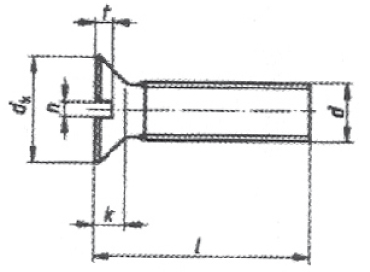
Countersunk head screws
In order for the head of the screw not to protrude from a flat surface, it has to be countersunk. We have already spoken about such screws above, with the hex socket versions, but the most widespread in everyday life are the straight-slot and cross-recess versions. The most typical for household use is the simple straight slot. Under works conditions, where rapid assembly is carried out with electric or air-controlled (so-called pneumatic) tools, they work at high rotational speeds compared to hand driving, therefore the various cross-recess versions are the most suitable, from which the driver bit does not easily turn out under the effect of centrifugal force.
Let us get to know the most widespread versions of cross recesses! Two kinds of cross recess form the basic versions, but developments are continuous in this field too, in order to achieve ever more perfect fit and force transmission. The two kinds of cross recess are the following: Phillips and Pozidrive. The Phillips (PH) is a relatively regular cross shape, while the Pozidrive (PZ) is a drive with a somewhat more spread-out plan, supplemented with auxiliary grooves, tapering inwards. The third version is the most sensible, which combines in itself the advantageous properties of both the straight and the cross recess. Its name is Freedrive, whose meaning is freely fittable: this drive is a combination of a straight and a cross recess in one head. For home use a simple screwdriver will do, but it is also easily fitted by machine, because the key fits stably and does not turn out of the head. It is applied in places where subsequent disassembly and reassembly is frequent, such as, for example, at the cover of the battery of certain electronic devices, etc. Abbreviations: sf. eh. and sf. kh PZ/PH cs
Raised countersunk head screws
These can likewise be classed in the category of countersunk head screws. The difference compared to countersunk heads is that the raised countersunk head bulges slightly out of the flat surface. This has primarily aesthetic and secondarily geometric reasons, since the drive fits better in the higher head, which guarantees a fit over a larger surface with the screwdriver. While with other screws the length dimension means only the length of the screw shank, with countersunk head versions the head is to be included in the length. We measure the length of raised countersunk head screws from the countersink to the end of the screw shank. In terms of their diameters they can be obtained from tiny M1 instrument screws up to a maximum of M12; larger sizes are typically only manufactured in small series on the basis of individual requirements. In terms of material grades the range of countersunk and raised countersunk head screws is much narrower than with the screw types listed previously, although steel 4.6, 4.8, 5.6, plastic 6.6, brass, as well as NONOX® A2 and A4 can also be obtained from these, typically with a tensile strength of 700 N/mm2. With these screw types the most resistant grade is unambiguously NONOX®. Abbreviations: lf eh. or lf. kh PZ/PH cs.
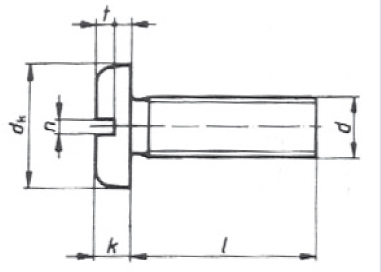
“D” head screws
With the “D” heads the same grooves exist as with countersunk and raised countersunk head screws, including the straight and the cross recess and the hexagon as well as the TORX socket, and the available sizes and material grades are also very similar. The main difference is that the head of D head screws bears fully on the flat surface and bulges out of it. Abbreviations: Df eh/ Df kh PZ/PH cs. Countersunk, raised countersunk, as well as “D” and cylindrical head screws are all most widespread in the metric (nut-fittable) version, but many of them also exist in self-tapping screw and wood screw versions.
Further versions: the so-called security screws preventing the access of unauthorised persons, eye, ring and carriage bolts, stud bolts, basin-fixing screws and many others, the description of which is limited by the length of the publication, but perhaps in a later article their presentation may also take place.
*3.6, 4.6, 5.6, 5.8, 6.8…
*The first digit means 1/10 of the tensile strength in N/m2, the 2nd digit 10% of the yield point, in %. E.g. 6.8 = 600N/m2, the yield point is 80% of this.

Leave a Reply