
Theft- and vandal-proof fasteners
Man created the screw, and with it the problem, because what God joins together, Man often takes apart even that. Well, we can no more regard the screw and the nut as the symbol of stable relationships than the wax candle as the symbol of fidelity. So let there also be screws that cannot easily be taken apart! — thus appeared the newer demand. And so Man created vandal-proof screws, which cannot easily be undone.
What makes a releasable joint unreleasable?
It is characteristic of vandal-proof, or security, screws that they can only be fitted with a special purpose-made tool — in this way they prevent unauthorised people from picking apart, with a penknife, a hairclip or the edge of a one-cent coin, the objects placed on public transport vehicles, in public spaces, in public institutions and in public conveniences, and thereby causing serious material damage or accidents.
The snake-eye security screw
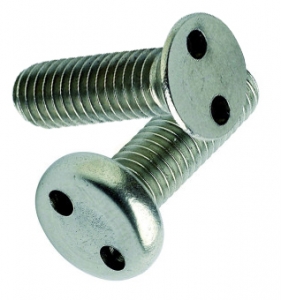
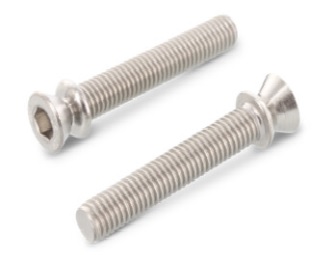
On the screw head — be it countersunk or dome head — there are 2 small, round drive holes. The purpose-made tool is a special screwdriver, with 2 small, round pins in place of its blade, which fit precisely into the holes of the screw head. The diameter of the holes and their spacing can be varied, so genuinely only someone who has the exactly matching purpose-made tool can undo the joint, just as in the case of a lock and its matching key. This type of driving tool is, by its very nature, not suitable for transmitting large forces. This is precisely why we do not recommend machine driving.
Pin Torx screws
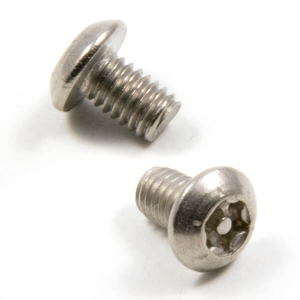
If security screws are needed in large quantities, then we rather recommend pin TORX screws; these can be screwed with a machine, even at high torque. The principle of pin TORX, pin hex socket and pin cross-recess screws is similar. The drives match those of ordinary TORX, hexagon socket and cross-recess screws in every respect, and the only difference is that in the middle of each drive a little pin prevents ordinary “L” keys, cross-recess screwdrivers or driver bits from being able to penetrate into the drives. Countersunk, dome and cylindrical head types are available, of which metric and inch “nut-type” versions as well as self-tapping and wood screws alike exist. The keys are deceptively similar to the ordinary versions; the only difference is that in each of their ends there is a bore into which the pin of the drive fits precisely. Better quality keys are all made of hardened, hard steel that is difficult to drill, so it is not easy to fabricate a key at home for pin security screws. It does no harm to keep the purpose-made tools in a safe place, because unpleasantness may arise for us if they disappear! Those who try to “convert back” the screw heads, that is, to remove the little pins, will be disappointed and will fail, because the pins are too thin to be drilled out, tough enough not to be broken off, but not tough enough not to be bent — and so the last chance of undoing the joint with the matching purpose-made tool can quickly be lost as well.
Once the little pin has bent, only the most cunning, most hair-raising interventions can solve, or indeed further complicate, the situation.
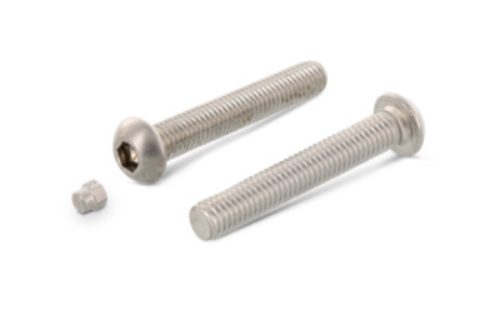
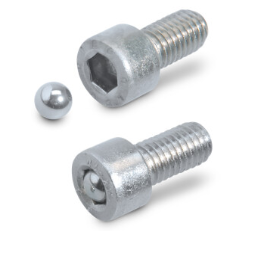
A clever solution for securing ordinary hexagon socket screws is the security plug, which simply has to be slid into the drive with its hexagonal end facing inwards, and then the joint finalised by hammering in the protruding cylindrical wedge. Its disadvantage is that it can only be removed by drilling out, which requires expertise and a steady hand as well as the appropriate tools. If a drive-in plug is not to hand, but there is a stainless steel ball that fits, that will also do, but that really is impossible to remove afterwards. (We certainly do not recommend a chromed steel ball, because that can rust quickly and ruin everything!)
Triangle-head screws
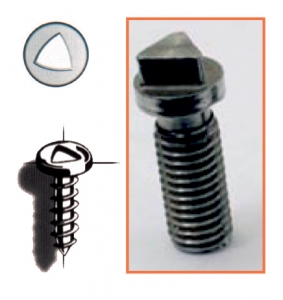
Making a spare key for triangle-head screws is awkward too — of course, the resourceful person finds a solution to everything. The best solution, however, is always the purpose-made tool, which can be obtained from the distributors together with the screws. Security screws are not “bomb-proof”, although the triangle-head screw is precisely what the trade calls them. The task of vandal-proof fasteners is merely to stop spontaneous vandals, and they do fulfil this mission. Unfortunately, against well-prepared pirates even more complex mechanical protection often proves insufficient.
McGard screws
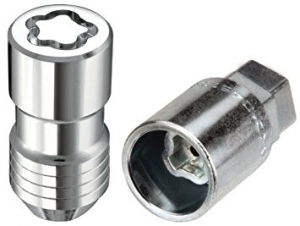
The daisy-flower-shaped drive of McGard screws is designed by computer. The complicated form is almost impossible to copy, so the screw can only be fitted, retightened or loosened with the original, factory tool. Because of its force transmission factors, which can be called perfect, it has also become widespread among the locking wheel bolts of motor vehicles.
One-way non-removable screws
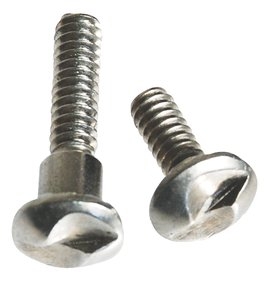
We recommend the next type both to those who do not joke about fixings and to those who like to play jokes on others. So-called “one-way” screws are guaranteed to satisfy the needs of both camps. The speciality of the type is that nothing else is needed to fit it than the simplest, most ordinary “screw-mangler” (but a plain EURO cent will also do…). The speciality of the head design — as its name shows — is that it can only be turned in one direction, and that direction is driving in. What would be the point, after all, if it could only be unscrewed?! Precisely the opposite happens: once we have driven it in, no amount of twisting and turning helps any more, the screwdriver simply turns out of the head.
Security nuts
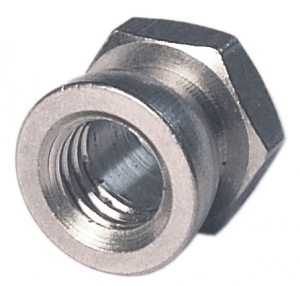
The concept of security fasteners of course includes not only the screws themselves, but also the nuts belonging to them. Here we mention two such nuts, of which the first is perhaps the most drastic and the second the most ingenious solution against joints being undone.
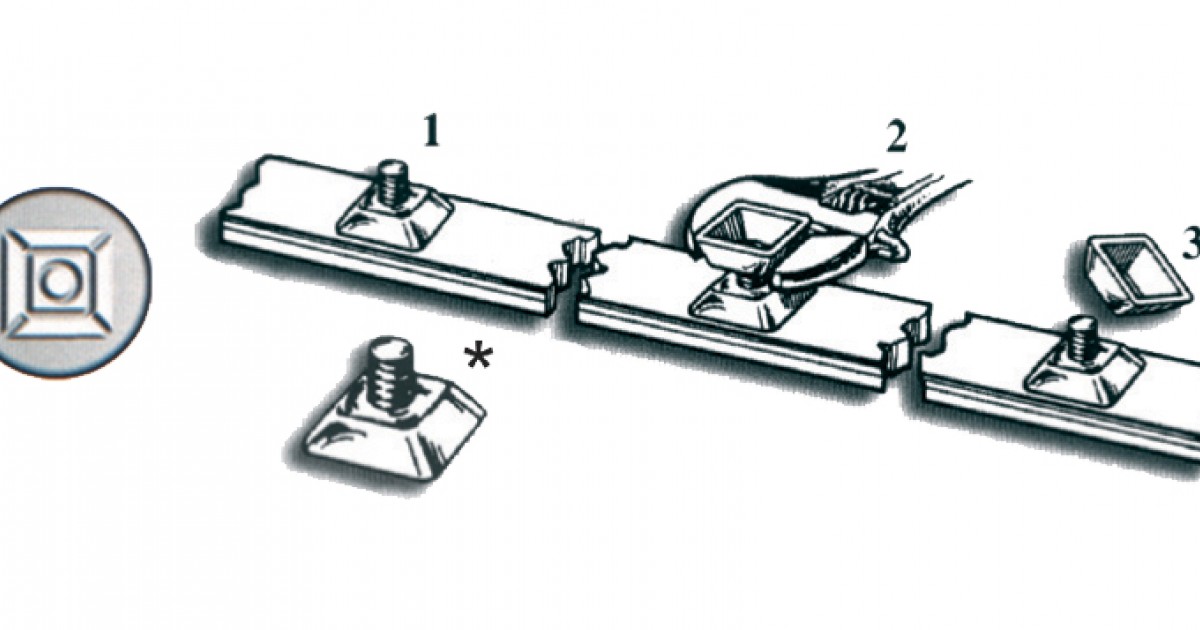
- The essence of the shear nut is that a cone with a curved surface and a conventional, hexagonal nut form one body, but the hexagonal part ensuring the tightening shears off under the effect of a set force value and can be removed. The remaining tapered part, on the other hand, provides what one might call a permanent joint, since because of its shape it is almost impossible to loosen it back with a tool. New is that from now on this version can also be ordered in NONOX A2 stainless grade, in screw format!
- An odd pair is what we might also call that security nut combination which requires two identical nuts for its fitting and removal. Use: turning the square nuts made of hardened steel plate to face each other, they must be started onto the screw thread by hand, and then, with the aid of an open-ended spanner inserted between the two, the pair must be tightened to the desired extent on the surface to be fixed. After we remove the auxiliary nut, its pair can no longer be loosened back, because of its tapered-smooth surface and the steely hardness of its material. If we do want to remove it, we need 2 things: another identical nut and an open-ended spanner.
How much do security screws cost?
Vandal-proof screws and nuts alike can be obtained in hardened carbon steel and NONOX (stainless and acid-resistant) grades. Security screws are not cheap, but why would they be?! If they did not cost several times as much as the ordinary, everyday versions, then they would become just as widespread in the wide world, and precisely that would be lost which enables these clever little devices to protect our valuables from unauthorised people, and they would be degraded back into ordinary fasteners.
The high price, then, if you like, protects the interests of users. The price is perhaps not so frightening if we relate it to the value of the valuable objects and equipment that they protect from vandalism and theft.
The cheapest security screw…
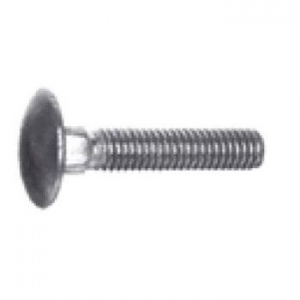
Well, to quickly create one more contradiction, we present an ordinary, completely everyday screw, from among the cheapest, which is capable of performing security functions (as well), and its price does not influence this in the slightest. This screw is the carriage bolt, with which we also return to the world of traditional fasteners.
This is an old trick, from the days of heavy wooden gates. The boarding of these gates was held together from the inside by iron straps, washers and nuts, and from the outside by large, flat, slightly domed screw heads. There is no groove or flat of any kind on the screw heads by which they could be gripped with any tool. During assembly the screw does not turn, because under the head — on the old versions nibs, and on today’s modern versions a square neck section — is located, which on tightening is drawn in and clamps into the fibres of the wood, and thus fixes the screw. If someone takes the trouble to file off, or otherwise remove, the domed head, then besides working very hard, they will not achieve success either, because beneath the visible head the square neck section, drawn tightly into the wood, continues to hold the shank inaccessibly. It can be obtained in ordinary 4.6 strength (400 N/mm2) galvanised steel, or in NONOX A2, stainless, or A4, acid-resistant grade (approx. 700 N/mm2 strength) steels.

Leave a Reply