
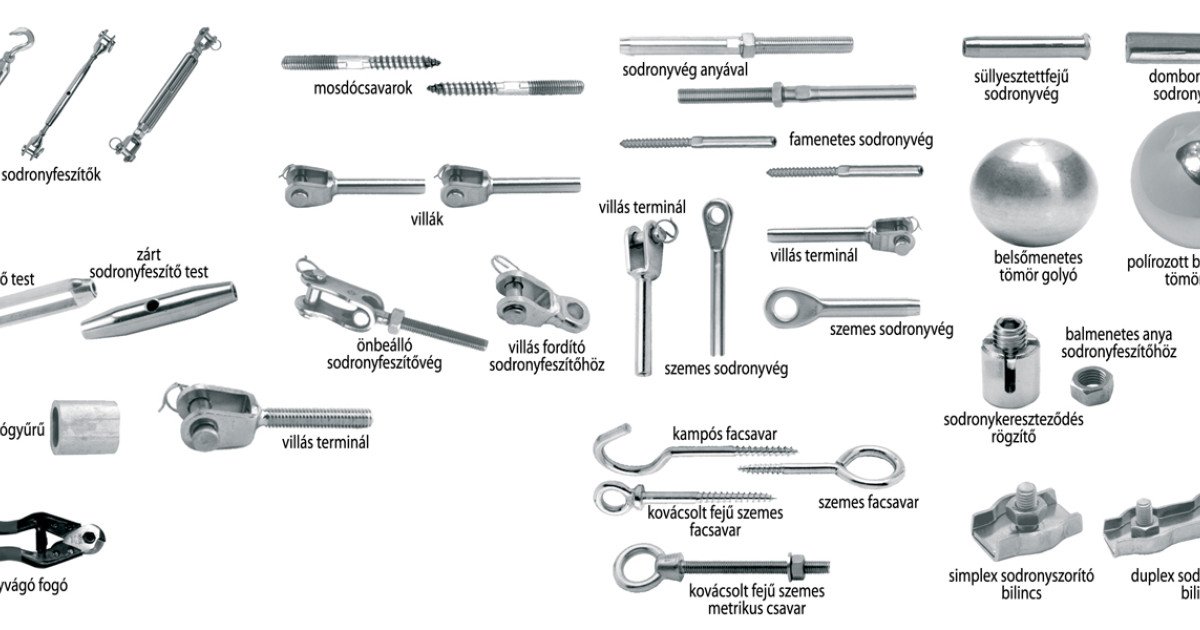
In this article we help you get an overview of the NONOX acid-resistant wire rope fittings range, for those who decide they would like to use wire rope as a structural or decorative architectural element.
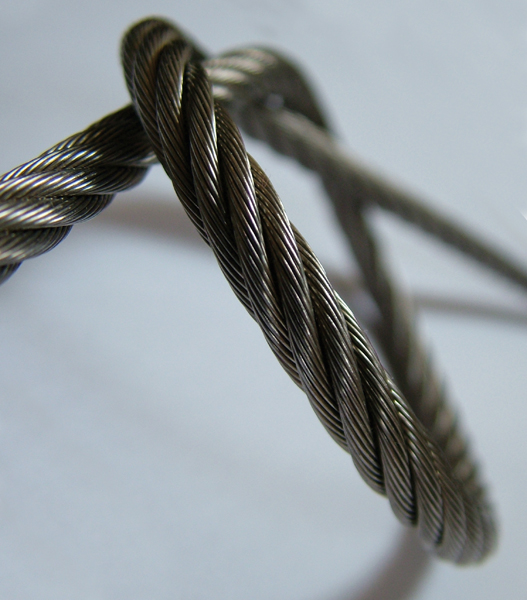
Whether it is a railing, a bracing structure or some other decorative element with no functional role, the accessory fittings play a part in how widespread wire ropes are, since wire ropes may need to be secured, tensioned and in places joined or branched as well.
Solutions for the end of the wire rope
Thimble and wire rope clip
The simplest, though perhaps not the most attractive, way of securing it is to fit each end of the wire rope onto a so-called thimble and fold it back, thus forming loops out of the rope itself. It is advisable to clamp the strands tightly together directly at the base of the loop, and at least at one further point, just like a tie knot at the shirt collar, then to secure the rear leg lower down, at the keeper. The most suitable fastening element for this purpose is the wire rope clip (see the picture below!)
In the case of flexible wire ropes, the simplex or duplex wire rope clamp performs the same function somewhat more elegantly (both can be seen in the composite picture below).
Swage ferrules (nipples)
If a suitable dedicated tool is available, we can use swage ferrules, so-called nipples, instead of clips. The swaging tool crimps the ferrule onto the parallel rope ends with the appropriate force, so that they can no longer move at all. To stop the rope ends from fraying, it is best to wrap a 2–3 cm section with insulating tape before cutting, then sever the strands in the middle of the taped section with a wire rope cutter. The blades of a wire rope cutter are not straight like those of a bolt cutter – although the shears themselves are similar – but are blades that cross one another in a curve, so the shearing force acts towards the centre of the rope. This way the diameter does not deform, and the cut strands do not stick out.
Securing wire rope ends
Hooks and eyes
The looped rope ends prepared with thimbles as described above can then easily be secured at the end points. The most suitable for securing are simple hooks or eyes (since an open thimble allows the eye bolt to be threaded through its opening beforehand). For wood, a wood-thread hook or an eye wood screw is called for; for steel structures, one of the metric-threaded, closed-eye versions may be considered.
Whether it is an eye or a hook depends mostly on whether we design the fitting to be easily dismantled afterwards or not. If we cannot decide this important question in advance, there is still a solution: the use of a fork terminal (see the picture below!).
Fork terminal
The clevis pin in the fork can be pulled out after removing the circlip, and the wire rope fitting can be dismantled, or reassembled again at any time.
Tensioning wire ropes
Since fork terminals are available in both right-hand and left-hand threaded versions, the wire rope can be tensioned without twisting by tightening right-hand and left-hand threaded nuts placed at its two ends. This is the situation if the receiving unit is a metal structure, where, pushed through clearance holes, we can simply tension the metric screws with the help of the nuts. But what if wire rope has to be tensioned between wooden beams using fork terminals? That can be solved too! In this case a right-hand and a left-hand hanger bolt must be screwed into the wooden beams, then a right-hand and a left-hand female-threaded fork terminal can follow, which we can tension in a similar way; its load capacity, however, is considerably lower than that of the male-threaded version fixed to a metal structure. Besides all this, we must watch out for one more important thing: with this method we can take up a maximum of 2–3 cm of slack on our wire rope!
Tensioning with a turnbuckle
Efficiency improves considerably if we carry out the tensioning with a turnbuckle. A turnbuckle consists of 3 parts: a body, which contains two opposed nuts, one right-hand and one left-hand threaded, plus one eye, hook or fork screw each to match them.
The tensioner can be inserted at any point along the wire rope. The operating principle of the tensioner: if, as a result of turning the tensioner body in one direction, one of the eye bolts built into the wire rope is drawn inwards into the tensioner body, then the opposite-threaded eye bolt facing it also travels inwards, so the wire rope is tensioned; turning it the other way loosens it.
Wire rope terminals
The word terminal comes from the Greek terma and means boundary or end point. Wire rope terminals are the name we give to those rope endings that receive the wire ropes.
Swaged rope endings
No thimble is needed, there is no need for a wire rope clip with screw ends sticking out, and besides, swaged rope endings (otherwise known as wire rope terminals) are neater and meet safety expectations excellently too. When the terminal’s sleeve, which receives the wire rope, is pressed under a press, the inner diameter grips the rope so tightly that it can no longer budge from its place. When selecting terminals, the required method of securing and tensioning the wire rope must be taken into account. If we place a right-hand and a left-hand threaded terminal at the two ends of the wire rope, tensioning is easily solved with nuts, and there is no need to insert an additional turnbuckle – only if we want to allow greater play for setting the length precisely, or to compensate for expansion. Male- and female-threaded rope endings are available with both right-hand and left-hand threads; we only have to decide whether we wish to solve the securing and tensioning on the steel structure with an open or closed nut, perhaps with a female-threaded ball, or with screws (e.g. a cylindrical or “D” head hex socket screw). It is no problem either if there is only a way to tension it from one side. Threadless closing terminals are available with small and normal head sizes, which meet all our aesthetic expectations (the range can be seen in the picture below). From its other end the wire rope can still be tensioned with a nut, a ball or a screw, or a turnbuckle can be inserted; in that case both ends can even be closed off without threads. Naturally, male-threaded, right-hand and left-hand swaged terminals can also be used with the turnbuckle, and by rotating the rope body the tensioning can be carried out with ease.
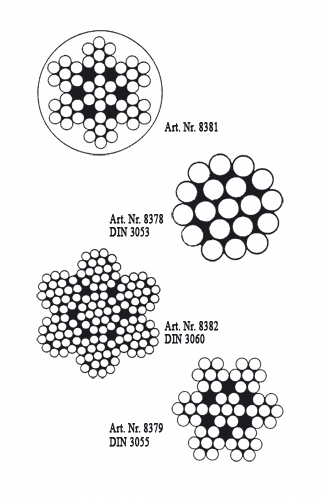
Our NONOX wire ropes:
- DIN 3053: 1×19 strand bowden (rigid, single-laid rope)
- DIN 3060: 7×19 strand wire rope (flexible, double-laid strand-spiral lay)
- DIN 3055: 7×7 strand railing wire rope (single-laid strand-spiral lay)

Leave a Reply