
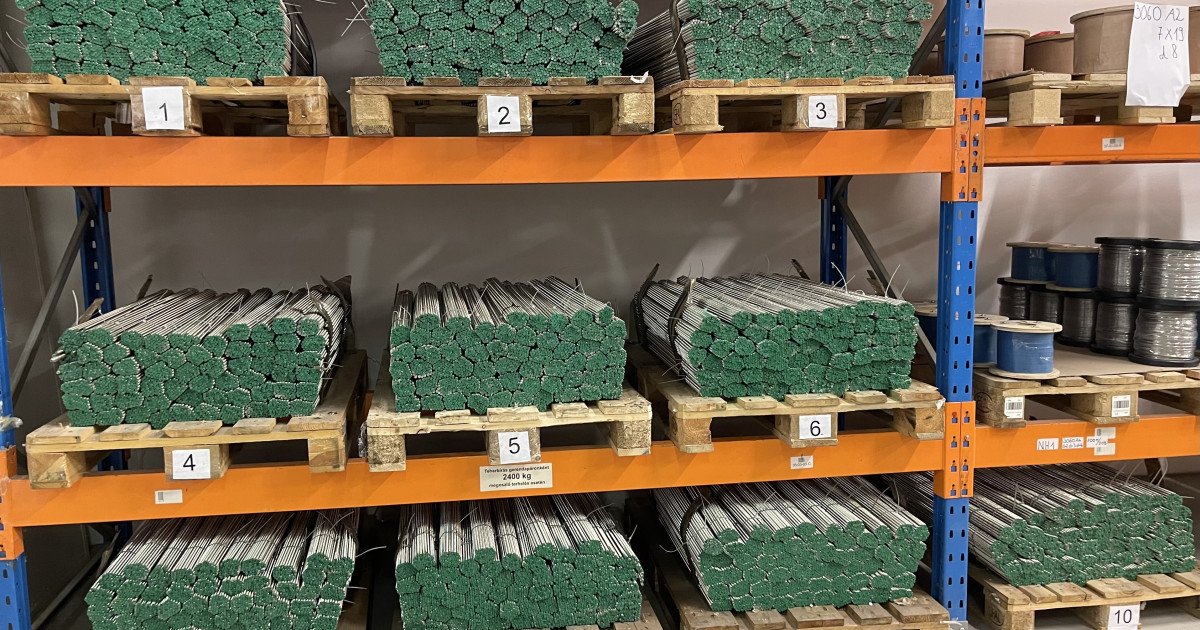
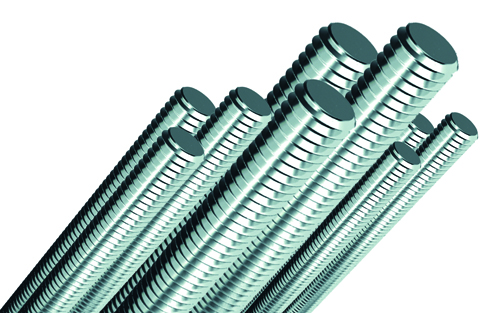
Some sell screws by the piece, some by the kilo. Threaded rod, however, is customarily asked for by the metre…
Threaded rod is an ingenious solution for all those who use screws that deviate from the standard, or simply screws of differing lengths, in alternation. Threaded rod has no head, just one continuous thread the whole way. It is rare for anyone to need the full length in one piece; typically it is cut to the length required for the job, and used that way. It can be cut with a saw, a cutting disc, parted off on a lathe… The technique depends only on what the task is and what the expectations are. If the cut piece goes into concrete or plaster, we can even snip one of its ends off with a bolt cutter, but let us take care that the thread is not damaged on the protruding end! The more experienced wind 2 nuts onto it and cut between them, then wind the nut off in the direction of the cut, and in this way it restores the damaged end. This way it is relatively quick and simple. Of course, under proper conditions the cut end can be chamfered at 45°, and there is no problem with starting the nut.
If, for example, 40 cm pieces were needed, then one 1 m rod would yield 2.5 pieces, from which it follows that approx. 20 cm from every rod would go to waste. This is not economical. In such a case it is worth starting out from 2 m rods, where in principle no waste arises, but we must take into account the material loss from cutting, which is the thickness of the cutting tool — this thickness must be subtracted once from the length of every cut piece! For the economical cutting of pieces of differing lengths you can order 1, 2 and 3 m rods from us.
You need it for continuous production, so there is no opportunity to cut it on site?
No problem! If a large quantity is needed, you can give us the exact size, and we will hand over the ordered goods to you cut to size, waste-free. It is also no problem if the quantity is not that large; you can order even a few rods cut to length, or with other machining (e.g. flattened, drilled end, etc.)
Making a grub screw from threaded rod?
I can assure you there is no need for this, since every kind of grub screw is available from us in stainless and acid-resistant steel alike. If you needed some special size, there is no need to despair either, because the ends of the pieces can be slotted as required, and they can then be gripped and driven with a screwdriver, but an external or internal hexagon can also be formed, if there is a demand for this — though these can only be carried out above M10 size. Ask for our quote! (+361-453-7060)
While we are at it, you can also order trapezoidal-thread rods, whose lead time is approx. 1–3 weeks (depending on size, grade and quantity). The purpose of trapezoidal threaded rods (TR) differs from that of the normal metric-thread version, since these are applied for force transmission (e.g. a vice).
Why stainless?
Because NONOX A2 and NONOX A4 raw material is resistant to acids and alkalis, so both outdoors and indoors this is the most suitable choice for you. Consider that galvanised goods start to rust outdoors within a few days, especially from their cut surface, which you should certainly repair! This, however, is extra time, and moreover it does not save the screw from rusting either. With stainless (A2) and acid-resistant (A4) materials you have nothing further to do, because on the cut surface the protection re-forms by itself on contact with the oxygen of the air, so you save time and energy in any case. (If the topic interests you, read this too: https://menet-trend.hu/nonox-vilag/anyagismeret-cikkek/hogyan-vedekezzunk-a-rozsda-ellen)
Tensile strength
There is one more consideration that it does no harm to take into account before you make a decision regarding procurement, and that is tensile strength. The tensile strength of traditional threaded rods is 4.6, which is 400 N/mm2, whereas the stainless version most commonly has a tensile strength of 700 N/mm2. You can find out more about tensile strength values here: https://menet-trend.hu/nonox-vilag/a-rozsdamentes-acelok-jelolesei
Don’t have a NONOX catalogue yet?! Please download the pdf version from our site: www.menet-trend.hu
Can stainless threaded rod be welded?
Yes, but only while observing the correct technology!
What else is worth watching out for?
Stainless and acid-resistant materials are prone to galling! This is not a material defect but a completely natural phenomenon, which can occur suddenly already at the first tightening. There is no need to be frightened of it, it can be guarded against! We recommend OKS 250 paste, enquire with our colleagues!
Can threaded rod be ordered by mail order?
In 1–2 m rods, certainly. We send threaded rods this way to the whole territory of the country every day. In the case of 3 m, ask for our quote!
What else is worth ordering alongside NONOX (stainless and acid-resistant) threaded rods?
A nut, a washer, a saw blade, a cutting disc for stainless materials, certainly. But you can also buy occupational safety equipment from us, e.g. gloves. Didn’t you know? Please call our sales colleagues on 061-453-7060, or send an e-mail to the info@menet-trend.hu e-mail address!
Main technical data:
- Standard number:
- DIN 975 (standard relating to 1, 2 and 3 m rods)
- DIN 976 (standard relating to pieces manufactured to size from DIN 975)
- Size scale:
- From M2 to M52
- Material grade:
- NONOX A2 (AISI 304, that is “stainless”)
- NONOX A4 (AISI 316, that is “acid-resistant”)
- Pack sizes: see the ordering page!
- Unit weights: please enquire with our sales staff, or look it up here: https://shop.menet-trend.hu/:m-975-menetesrud
Please click here and fill in our survey! For filling it in we give a free OKS paste sample.
Explanation of terms:
1. “Whitworth” refers to a thread profile type developed by Sir Joseph Whitworth in the 1840s. The Whitworth thread is a standardised, triangular thread profile, which was originally used widely in the United Kingdom and in other countries as well, especially in mechanical engineering and in construction. Its most important characteristics: • The thread profile angle is 55 degrees. • The Whitworth thread system standardised the sizes and thread pitches of screws and nuts, which promoted the compatibility of the products of different manufacturers. Although today the ISO thread is mainly used worldwide, Whitworth threads can still be found in older machines and equipment, especially in the United Kingdom and in the British Commonwealth.
2. Trapezoidal thread: The “trapezoidal thread” is a special thread type whose cross-section is trapezoidal in shape, in contrast to the usual triangular threads, such as, for example, metric or Whitworth threads. The trapezoidal thread is often used on machines and equipment where the transmission of greater forces or the conversion of motion is needed, for example in spindles and lifting structures. Its main characteristics: • Their cross-section is trapezoidal in form, the thread profile angle is generally 30 degrees. • It is more powerful and bears a greater load than traditional threads. • The threads provide greater efficiency in converting linear motion into rotary motion, so they are often used in machine tools, machine spindles, screw jacks, and precision linear motion systems. Because of its high strength and good wear resistance, the trapezoidal thread is ideal in situations where a long service life is needed and large loads have to be coped with.
Leave a Reply