
Let us begin with a little overview:
01The advantages of the assemblable wire rope end (Updated 10.06.2020)
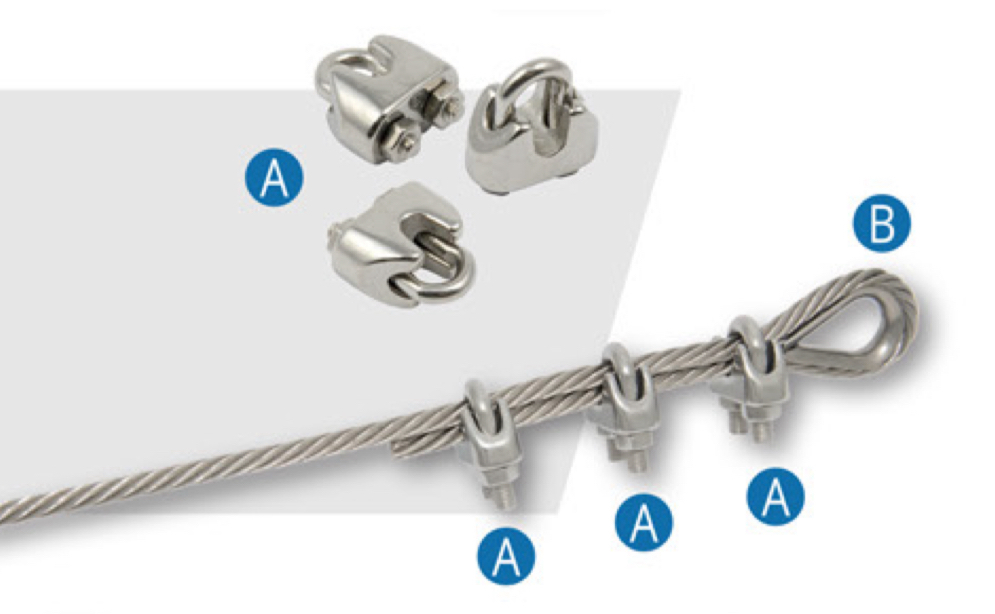
The simplest way of fixing is to loop the ends of the wire rope back through a so-called rope thimble, and then to fix the strands tightly clamped together directly at the base of the loop and at at least one or two further points. One fixing element for this purpose is the traditional wire rope clip (U clip).
When swaged wire rope ends are used, by contrast, the wire rope is not folded back, there are no protruding screw ends, and accordingly this is a far neater solution.
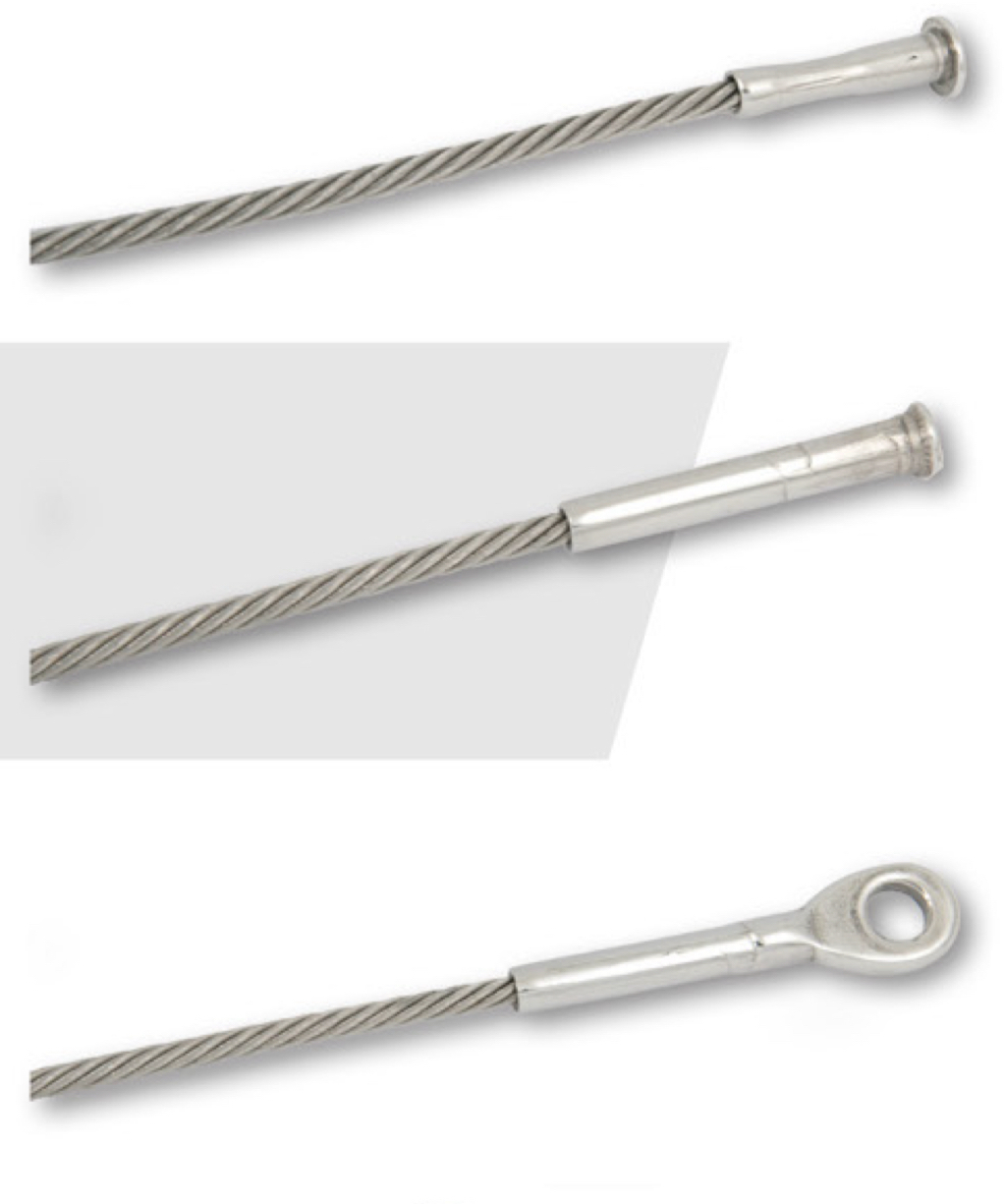
The essence of the swaging method is that the sleeve of the terminal enclosing the wire rope is pressed under a press, so that it clamps onto the wire rope and can no longer budge. Its disadvantage is, on the one hand, that a press machine is needed for the swaging, and on the other hand that after swaging the joint can no longer be undone; if something has not turned out well, then that section of wire rope, together with the end fitting, has become scrap. NONOX assemblable wire rope ends are made of acid-resistant steel, so in outdoor, waterside or industrial use they resist corrosion over the long term as well, while providing an aesthetic solution.
With assemblable wire rope ends, however, these disadvantages can be eliminated, since, as their name reveals, they provide a releasable joint with the wire rope end without the wire rope having to be looped. Let us use assemblable wire rope ends at locations where the technical task has to be solved on the spot, there is no way of pressing, and the aesthetic appearance matters a great deal.
02The components of the assemblable wire rope end
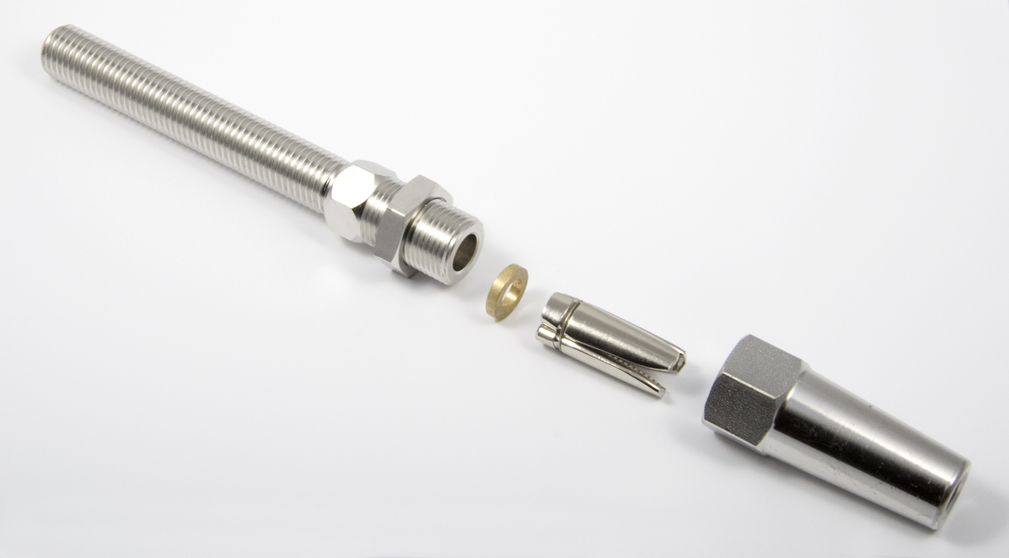
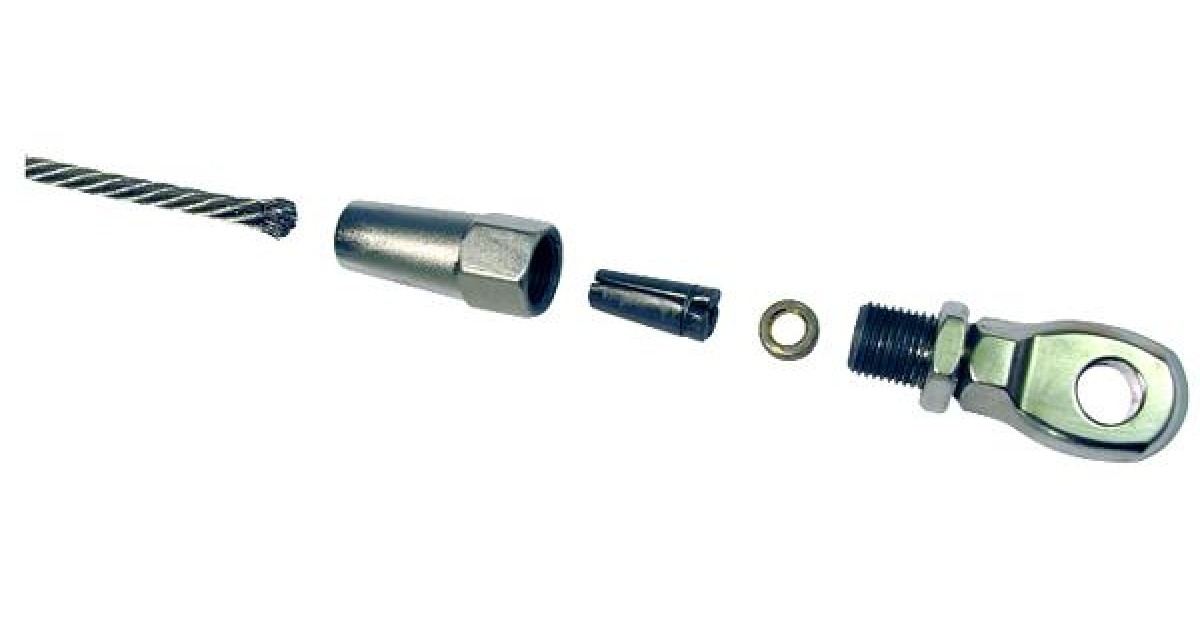
The assemblable wire rope end consists of four components. The main element is the end fitting itself, which can be of several designs depending on the field of application. The tapered cap connects to the end fitting with a thread. Inside the fitting there is a likewise tapered counterpart and a washer. When we screw the cap onto the end fitting, the two tapered components clamp the wire rope. Under the effect of tensile force the two cones slide into one another still further, so the greater the force straining the wire rope, the more tightly the end fitting grips it.
03The assembly procedure
After we have unscrewed the fitting, let us thread the threaded cap onto the end of the wire rope. Next comes the placing of the tapered counterpart. With some types the counterpart consists of several parts; these must be placed onto the wire rope, and its operating principle is the same as the operation of the chuck of a drill. After we screw the fitting together, the cone segments clamp onto the wire rope. With the other type of assemblable wire rope end, a brass cone fills the role of the counterpart. With this solution the outer strands of the wire rope must be untwisted and the cone must be drawn onto the exposed central strand so that the central strand protrudes 2 mm beyond the end of the cone. After screwing together, the outer strands clamped between the two cones ensure the appropriate holding force. The tool requirement for the assembly and disassembly of the components is no more than two open-ended spanners, or a vice and an open-ended spanner.
In the case of quality assemblable wire rope ends the raw material is particularly important: the NONOX A4 acid-resistant version ensures durability and safety even under extreme loads.
For cutting and assembling wire ropes, always use protective gloves!
Choose NONOX acid-resistant assemblable wire rope ends for long-term, safe and elegant wire rope fixing!

Leave a Reply