
NONOX hinges – an industry and technical summary
The role of hinges is to connect two components in such a way that they can turn relative to one another – typically a fixed and a moving part (e.g. a door and a frame). This simple yet extremely versatile mechanism is to be found in almost every industry in the world. The choice of hinge shapes and types is very large indeed, and for every task the right one either exists or can be developed – which is precisely why we present only a few possible versions here.
The players in this subject are the zsanér and the diópánt – the hinge and the barrel hinge. What do these names mean, where do these interesting designations come from?
• Zsanér (hinge): a word of French origin (charnière), used in most languages for the general hinge type. In Hungarian too the word “zsanér” became the everyday, general designation for hinges consisting of two leaves and a central pin.
• Diópánt (barrel hinge; literally “walnut hinge”): the name comes from the fact that the pivot point (the centre of the hinge) was given a walnut-shaped housing, which is rounded or barrel-shaped. This is not only a structural element surrounding the pin, but at the same time a decorative one.
The principal roles of hinges
- Creating a movable connection: They make it possible for a structure (door, lid, window, etc.) to be opened and closed while remaining stably fixed to the other element.
- Carrying weight and load: The hinge bears the weight of the moving part – for example the entire mass of a door – so its load capacity has to withstand the share of the moved component’s mass that falls on it.
- Providing an axis of rotation: The hinge determines in which direction and at what angle the given structure can be opened or closed.
- Providing access: With hinges, places that need to be maintained, inspected, cleaned or refilled become openable and closable (e.g. electrical cabinets, machine housings).
- Security and functionality: Certain hinges can also perform an anti-theft or opening-prevention function (e.g. concealed, non-dismountable versions).
- Aesthetic role: In an aesthetically designed environment it is important that the hinge fit the given fixture not only functionally but visually too (e.g. trapezoidal, mirror-polished or satin-brushed hinges).
The typical fields of application of NONOX hinges and the special expectations
- Food industry – hygienic, easily cleanable acid-resistant materials preferred
- Chemical industry – strong corrosion resistance required
- Machine manufacturing – various sizes and types, with high load capacity for increased loading
- Shipping – hinges resistant to seawater and sea spray (A4 grade), matching the surroundings in appearance (e.g. satin-brushed or mirror-polished)
- Construction industry – both weldable and boltable types, in versions of differing load capacity
- Energy industry – for example outdoor electrical boxes, concealed or protected, corrosion-resistant hinges
- Telecommunications – weather-resistant closed or concealed versions in various thicknesses, for the sake of security
- Hotel and commercial-kitchen maintenance – aesthetic, stainless versions for interior doors and storage units; in wellness departments chlorine-resistant, A4 versions
Types and characteristics
• NONOX hinges with and without holes
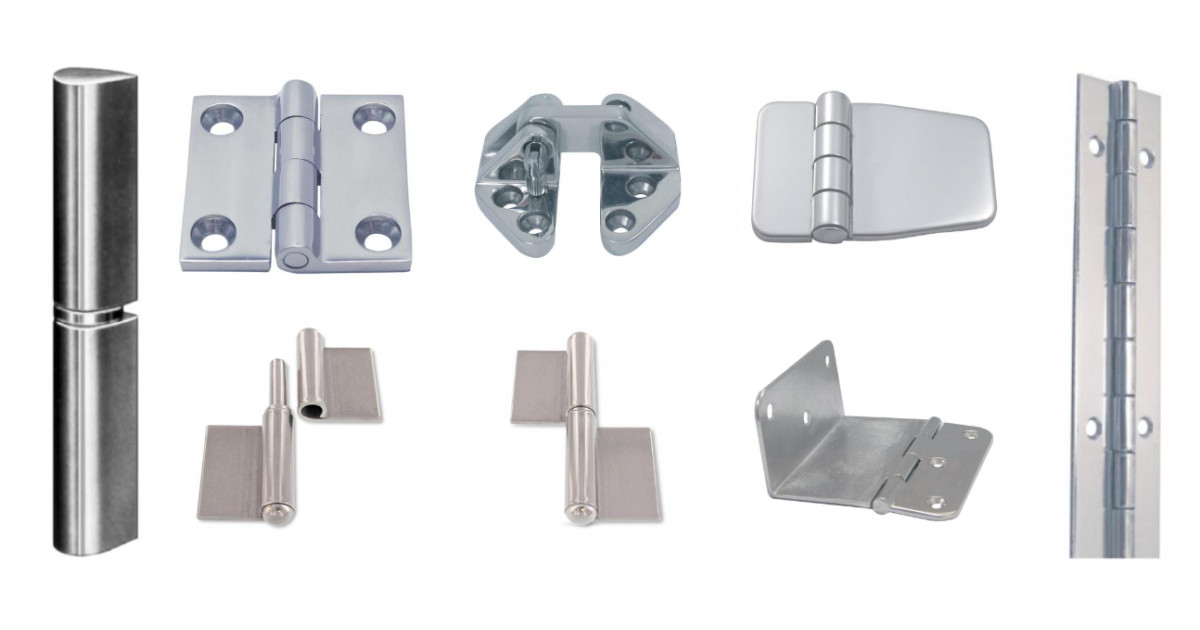
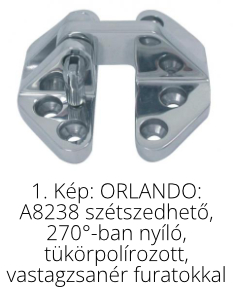
◦ with holes: with pre-drilled, proportionally placed holes, for bolting and riveting (pictures: 1, 4-6, 8.)
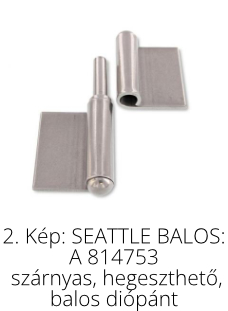
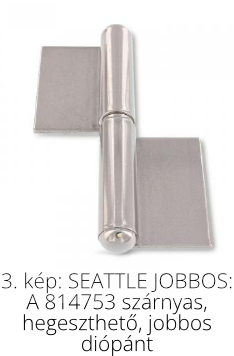
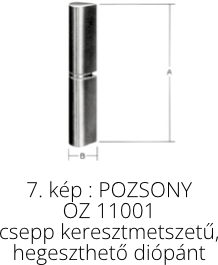
◦ without holes: they can be fixed by welding or by drilling holes as desired (pictures 2-3, 7)
• By material (only the stainless or acid-resistant versions)
◦ bent from sheet – in 1–3 mm thickness
◦ hot-formed – above 4 mm, for heavy loading, or for aesthetic reasons (picture 1)
◦ plastic – for special chemical-resistant environments
• Surface finish
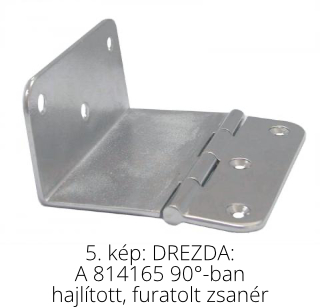
◦ untreated (in an industrial environment, where materials are similarly finished) (pictures 4-5)
◦ polished (mirror-finish): elegant appearance, e.g. on ships (picture 1)
◦ satin-brushed (satinised): for a modern, discerning environment (picture 8)
• Mountability
◦ weldable: exclusively onto the same base material, e.g. acid-resistant onto acid-resistant steel
◦ boltable, rivetable: onto galvanised, painted, aluminium or plastic surfaces too
• Range of movement
◦ it may open fully (close to 360°), or stop at an end position (pictures 2-4, 7)
• Right-hand–left-hand design
◦ the direction of the pin determines which side it suits (a universal type also exists)
• Dismountability
◦ on some hinges the spine (the pin) can be pulled out
◦ on others the design is closed and the pin is not accessible
Special solutions
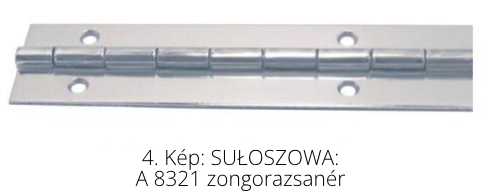
• piano hinges – in defined lengths (e.g. 1, 2 and 3,5 m), which can later be cut to size as required (picture 4) It exists in versions with and without holes.
• types with differing leaf lengths or shapes – e.g. one leaf 30 mm, the other 70 mm, or one of them bent in order to fit the contour of the structure (picture 5)
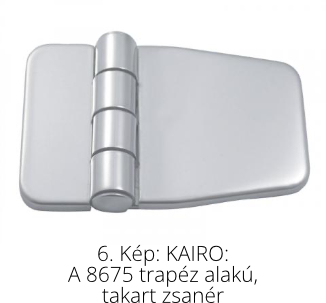
• aesthetic role – in some places they function not only as a technical but also as a decorative element (picture 6)
What is the difference between the hinge and the barrel hinge?
Barrel hinge (picture 7)
• Typically a higher load capacity and more robust design, used mainly on full-size wooden, metal or plastic interior or entrance doors.
• The “walnut” (ball- or barrel-shaped) part is visible; this is at once the pivot point and the decorative element.
• Generally a smaller part of the barrel hinge is visible, since part of the leaves sits in a recess in the material of the door and the frame, or is welded onto it.
• It is often made of solid material (casting or thick forged steel), and so has a long service life.
Hinge (picture 8)
• Available in a wide range of sizes – it may be quite tiny (for an instrument cover) or larger (for gates).
• It is often of a simpler and thinner design than the barrel hinge.
• Mounted on the surfaces, it is visible in its entirety or for the most part.
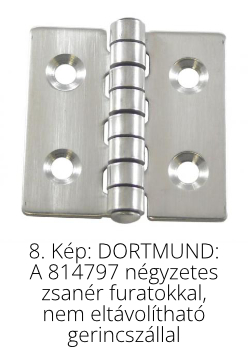
• It is used rather for smaller doors, furniture doors, cover plates, boxes and machine-housing doors, but industrial-size hinges also exist.
We offer you stainless hinges in a far wider range than the versions listed; you can view and choose them in the shop. If you need help, do not hesitate – call our sales staff on +361-453-7060, or write to us at the info@menet-trend.hu email address!
Our downloadable building hardware catalogue contains various hinge and barrel hinge types.
Order it in our online shop:
1. ORLANDO: A8238 dismountable, 270°-opening, mirror-polished, heavy hinge with holes
2. A 817753 leaved, weldable, left-hand barrel hinge
3. A 817753 leaved, weldable, right-hand barrel hinge
5. DREZDA: A 814165 90°-bent, drilled hinge
6. KAIRO: A 8675 trapezoidal, concealed hinge
7. OZ 11001 teardrop-section, weldable barrel hinge
8. DORTMUND: A 814797 square hinge with holes, with non-removable spine
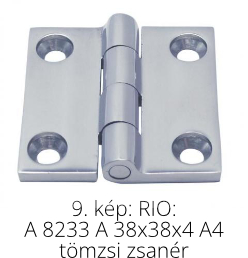
9. The article’s namesake, the RIO hinge: A 8233 stubby hinge
Did you find the article useful? Read our posts on similar topics too:

Leave a Reply