
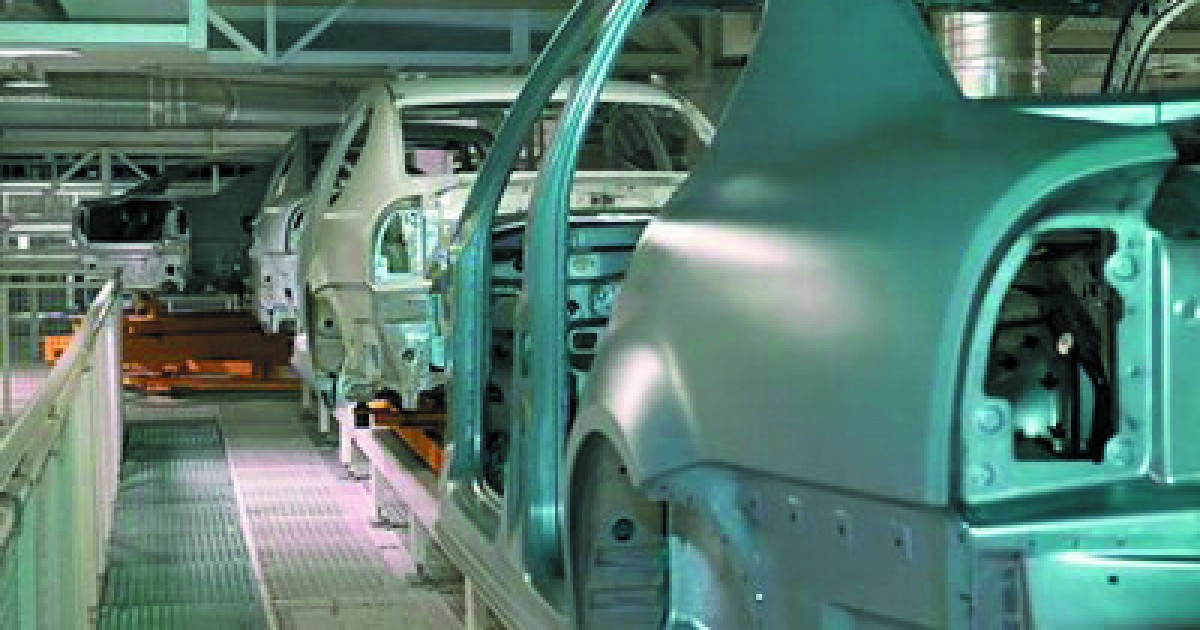
Structural steels
Materials such as steel are things we encounter primarily in practice, as users, so it is worth discussing some of their properties on the basis of their fields of application.
Non-alloy structural steels
Such steels are usually supplied in the hot-rolled or forged condition, and their mechanical properties are specified. They are used as elements of steel structures or machined by cutting. The quality of the products is established on the basis of the following:
- tensile strength [N/mm2]
- yield strength [N/mm2]
- elongation at fracture [%]
- specific fracture energy [J/cm3]
- chemical composition [%]
These steels are very widespread, but for more demanding machine parts heat-treatable steels are used.
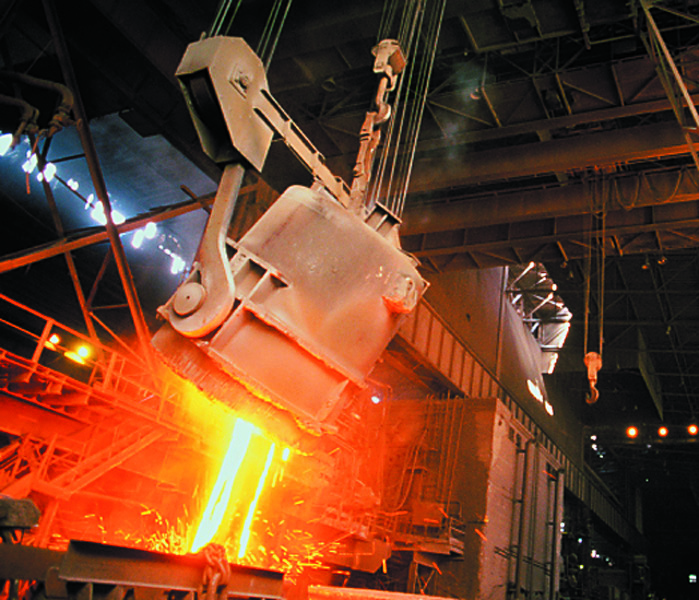
Weldable steels
We find numerous welded structures around us. With the steels used as their base material, weldability must be examined alongside the appropriate mechanical properties. In order to avoid cold or hot cracking, the steel should not be hardenable and should not contain contaminants causing hot shortness. Fundamentally, steels with a carbon content of less than 0.2% are weldable. In order to increase strength they are micro-alloyed or alloyed. This also saves weight and material. The total quantity of the micro-alloying elements (Al, Nb, V, Ti, N, Zr) is max. 0.15%. Their main task is to stabilise the grain boundaries and preserve the fineness of the grain, and thereby keep the yield strength high. The field of application of weldable steels extends up to 250°C. For structures operating above this but below 500°C, the main requirement is the prevention of creep, for which (Cr, Mo, V and Ni) alloying elements are used.
Low-temperature-tough and creep-resistant steels
Steel structures may only be made of materials whose impact energy value meets what is prescribed at the given temperature. As an alloying element at temperatures below -60°C, Ni is used, so these steels are not prone to embrittlement. Their main field of application is refrigeration. They are the materials of structures operating at temperatures above 250°C. Also classed in this group are the types of steel used for pressure vessels and boilers, which have high strength even at elevated temperature. Such are, for example, the steel types used for internal combustion engines. At temperatures higher than 500°C, special heat-resistant and creep-resistant steels are used, and above 1000°C Co- and Ni-based alloys or composites.
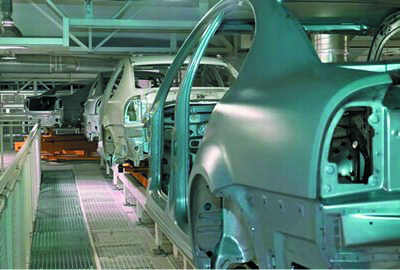
Cold-formable steels
They have a very large role in the manufacture of car bodies, since parts produced by plastic cold forming require mild steel with a high deformation capacity. For such a purpose, steels with a carbon content of less than 0.2%, with low contamination, well finished on the surface, and generally rimming, can be used. Formability is influenced by the grain size of the ferrite and the shape of the pearlite. Low-carbon rimming steels are prone to ageing, so V and Al alloying elements are used at 0.02-0.04%, but the processing of the sheets must be carried out within six weeks of delivery.
High-strength elements of machine components
The more demanding parts of our machines are installed in the heat-treated condition. As a result of heat treatment the properties can be varied within very wide limits, and thus set to suit the conditions of use.
Quenchable and tempering steels
Machine parts under significant load are made of such steels. Such are, for example, shafts and gears. For the sake of dynamic loading, quenchable and tempering steels have a high yield and fatigue limit and appropriate toughness. As a result of quenching and tempering, these properties of the steel increase significantly compared with the annealed condition. The carbon content of quenchable and tempering steels is a minimum of 0.25% because of hardenability, and a maximum of 0.6% because of the reduction in the impact energy value. In practice the carbon content of most quenchable and tempering steels does not exceed 0.45%. Among the non-alloy steels, the carbon steels can be quenched and tempered, and these are even more resistant to dynamic loading. Their carbon content ranges between 0.22-0.6%. But the favourable properties of carbon steels can only be achieved in small section diameters.
Alloyed, quenchable and tempering steels
With quenchable and tempering steels, (Mn, Cr, Mo, V and Ni) alloying elements are generally used, which primarily increase the through-hardenable diameter. The purpose of alloying with structural steels is:
- increasing the through-hardenable section diameter
- increasing strength
- reducing temper brittleness
- reducing the critical transition temperature
- increasing the specific impact energy and toughness
Tool steels
Tool steels are difficult to separate from other steels, since tools are made from corrosion-resistant steels too, for example. Depending on the field of application, a great many requirements arise with regard to tool steels, but the general requirement is that the tool steel should be harder than the material to be machined. Satisfying such wide-ranging needs can only be achieved with different steel types, on the basis of which we distinguish the following quality groups:
- Non-alloy tool steels
- Alloyed tool steels (Within this we distinguish the tool materials of cold and hot forming, and the high-speed steels.)
Non-alloy tool steels
The hardness of the steel is provided by martensite, which we produce by rapid cooling. As the carbon content increases their hardness increases, which they do not lose even during low-temperature tempering. The field of application is bounded by the size, the strength, the toughness, and the usable temperature between 150-300°C. Those with a lower carbon content (0.5-0.6%) are tougher, and are the base materials of hand and agricultural tools. And from the materials with a higher carbon content, chisels, shears, files, knife and razor blades are made.
Alloyed tool steels /cold-forming tool steels/
The main requirement for tools forming metals in the cold condition is wear resistance and high surface load capacity, but toughness can be important too. The purpose of alloying is: increasing the hardness and wear resistance, which generally takes place with carbide-forming alloys (W, Cr, Mo), and increasing the through-hardenable section diameter (Cr, Mn). Practically every non-alloy tool steel can also be regarded as a cold-forming steel.
Alloyed tool steels /materials of hot-forming tools/
Hot-forming tools, such as extrusion tools, hot cutters etc., have to meet a great many requirements. These steels must be heat-resistant, creep-resistant, wear-resistant even at high temperature, hard and tough. Such properties are provided, alongside the lower carbon content, by the (Si, Mn, C, Ni, W and V) alloying elements.
High-speed steels
High-speed steels were developed as the base material of cutting tools working at high speed. The edge of the tools heats up to as much as 600°C during machining, so a good high-speed steel is required to have high hot hardness and to retain it for a long time. Toughness is also a necessary condition for cutting tasks. The classic type of high-speed steel is R3 (the so-called 18-4-1) W-Cr-V high-speed steel with a 1% carbon content, the material of cutting tools and twist drills. But the most widespread type is R6, which is cheaper and contains fewer alloying elements. High-speed steels require special heat treatment. In order to dissolve the carbides the austenitising temperature is high (approx. 1200°C); because of their poor thermal conductivity, the rate of heating can only be low. They harden in oil, in air or in a salt bath.
Heat-resistant alloys
As a consequence of the development of industry and technology, ever greater operating temperature, pressure and stress prevail in individual machines. Only under such conditions is it possible to increase efficiency and performance. The upper limits of the operating temperature can generally be set by the structural materials. In some equipment operating at temperatures higher than 500°C the mechanical loading is not significant. Here the main aim is to eliminate or halt surface oxidation. We call such alloys heat-resistant. Their main alloying elements are (Cr, Si and Al), which form a dense oxide layer on the surface of the steel. If at higher temperature we also expose the material to mechanical loading, then the elastic limit must be raised with alloying elements that prevent creep. To prevent the surface oxide layer from detaching, it is necessary that allotropic transformations involving a change in specific volume do not occur during operation, which is why the alloys have a homogeneous, ferritic or austenitic structure.
Corrosion-resistant and acid-resistant steels
Non-alloy steels are not resistant to acids, the atmosphere, water vapour and other corroding effects, which is why stainless and acid-resistant steels have taken on an ever greater role in industry. The oxide film on their surface is not dense enough, it does not seal the metal off from the corroding medium, so it does not prevent further corrosion. The corrosion resistance of steels can be increased with alloying elements, which is possible as follows: alloying elements must be used which create a thin, well-adhering film on the surface of the steel that separates it from the corroding medium. For this purpose Cr and Al are used in a quantity of approximately 1%. Another possibility, in order to increase corrosion resistance abruptly, is if the quantity of the alloying element in the steel is a whole-number multiple of 1/8 atomic weight part. Corrosion-resistant steel contains at least 12% Cr, generally Ni, and occasionally other alloying elements. This way the alloyed steel is permanently resistant to the effects of temperature and pressure, and indeed to certain chemical and electrochemical effects as well. Because of their good corrosion-resistant properties, austenitic chromium-nickel steels are also called acid-resistant steels. These alloying elements exert their favourable effect alongside a low carbon content. In general a carbon content greater than 0.12% cannot be permitted, but only steels with a carbon content of at most 0.03% are resistant to intergranular corrosion. The use of austenitic corrosion-resistant, stainless and acid-resistant steels is very wide-ranging. They are used everywhere from the manufacture of vessels, tanks and medical instruments to the chemical industry. It is important that their behaviour during machining differs significantly from that of the steels generally used. These steels can be used at low temperature too without the danger of brittle fracture. They are tough at low temperature and heat-resistant, and generally contain 17-20% Cr and 8-24% Ni alloying elements.
Steel castings
A steel casting is the foundry end product that receives its final shape by pouring liquid steel into a mould made of sand, metal or other refractory material, and then solidifying. They are made of non-alloy and alloyed steels. The effect of the alloying elements (C, Si, Mn, P) is the same as described under the properties of steels.
However, the range of application of steel castings is decreasing, because of their high moulding and melting costs. Naturally, in the future too there will be areas where the use of these castings is indispensable.
Glossary:
Austenitic: a steel structure in which the carbon is present in dissolved form, which is why the steel is non-magnetic, elastic, easy to form and resistant to rusting.

Leave a Reply