
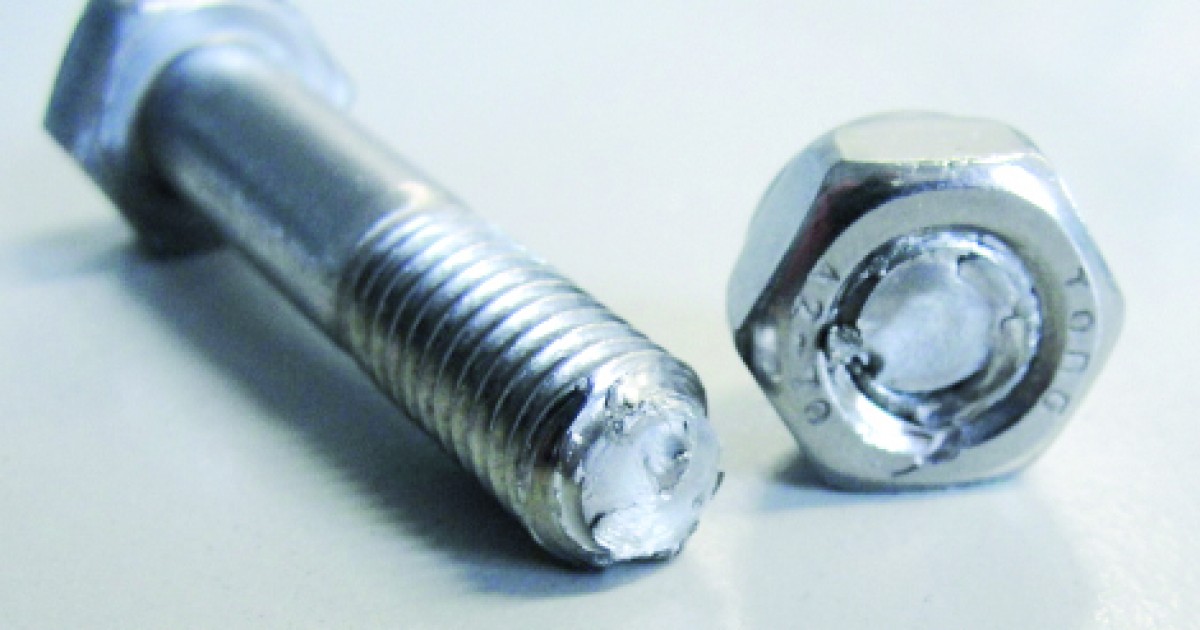
Galling of stainless and acid-resistant screws is not caused by a material defect, but by mechanical irregularities and/or failure to follow the assembly technology. You can find out here, point by point, what that technology is:
Handling and damage prevention
- 1.Handle the screws carefully, and avoid every possibility of mechanical damage to them, such as knocks, indentations, bending, burring or contamination.
- 2.Avoid using damaged or contaminated screws. If small marks or knocks are visible on the thread of the screws, do not use them. Damage like this can arise, for example, during incorrect loading, transport, storage or use, when the screws knock against one another and damage each other’s threads.
- 3.Avoid using threads that are damaged in some other way, rough or ragged as well, because these can also lead to binding and galling. If screws like this reach you, have them replaced by your supplier, because there may even be manufacturing-technology reasons behind them.
Lubrication and surface protection
- 4.In every case use an anti-seize paste or spray intended for assembling austenitic stainless or acid-resistant screws, because with this you can prevent galling.
- 5.Avoid using any other lubricant that makes the threads excessively slippery, because these can change the friction conditions and thereby the characteristics of the joint as well, while at the same time they do not necessarily prevent galling.
- 6.Do not paint the screws, and do not coat them with any material that could cause the threads to clog or the appearance of the surface to change. The surface must remain metallically clean at all times. The natural oxide layer protecting the surface of the screws restores itself after damage, but only if the surface can come into free contact with the oxygen in the air.
- 7.Do not attempt to give stainless or acid-resistant fasteners with an austenitic material structure galvanic surface protection. These are corrosion-resistant in their material, so no further surface protection is needed; moreover, the coating can adversely affect the tolerance values and the ease of assembly as well.
Cleanliness in the thread
- 8.Avoid the screws getting dirty too, because clogging of the threads can lead to binding and galling during screwing, particularly if the thread is greasy or oily and the dirt sticks to it more easily.
- 9.Particularly avoid metal chips or other particles originating from other work phases coming into contact with the threads of the screws and nuts, partly to avoid galling and partly to avoid corrosion contamination.
During assembly
- 10.Do not assemble with heated screws, because thermal expansion can cause the screws to bind and gall.
- 11.If you use a screwdriving machine, do not use a high speed, because this can cause heating on the one hand and binding on the other, which can also lead to galling. As soon as you feel the screw starting to bind, stop driving it and, after a short time, continue at a lower speed.
- 12.If you are assembling by hand and you feel the screw starting to bind in the nut or in another austenitic thread, stop driving it, gently unscrew the screw, and check whether there is any damage on the screw’s thread — particularly on the part where you felt the binding — or in the nut. If you see damage, replace the damaged fastener with a flawless one, and only then continue the work.
Material pairing and sourcing
- 13.If you are assembling with austenitic stainless or acid-resistant screws, use a heterogeneous joint where possible, for example an A4 nut with A2 screws, or vice versa. A4 and A5 materials typically contain 2–3% molybdenum, while A1–A3 materials typically contain no molybdenum.
- 14.Only obtain fasteners from a reliable source, where you are confident of their compliance with the prescribed standards, and along with that of the accuracy of the tolerances too.
- 15.If you find damaged screws or screws prone to binding in a screw consignment in a quantity greater than 1–2%, do not continue the assembly, but contact your supplier without delay and ask them for help or, in justified cases, for a replacement.
Torque and intended use
- 16.Do not apply a greater torque than the specifications for the screws.
- 17.Only use the fasteners as intended, and do not try to force another fastener into an application it was not originally designed for.
- 18.Do not use fasteners with a material grade, tensile strength or other characteristic differing from that laid down in the specifications. In the absence of specifications, take the manufacturer’s or the distributor’s recommendations into account.
- 19.Do not mix fasteners with an austenitic material structure, marked A1–A5, with other fasteners, for example carbon steel ones, regardless of whether they have surface protection and, if so, of what kind.
- 20.Do not modify the fasteners, because by doing so you may not only bring about galling, but at the same time you may also lose every legal basis for requesting a replacement on account of it.
Further information here:
About the galling of stainless screws and acid-resistant screws

Leave a Reply