
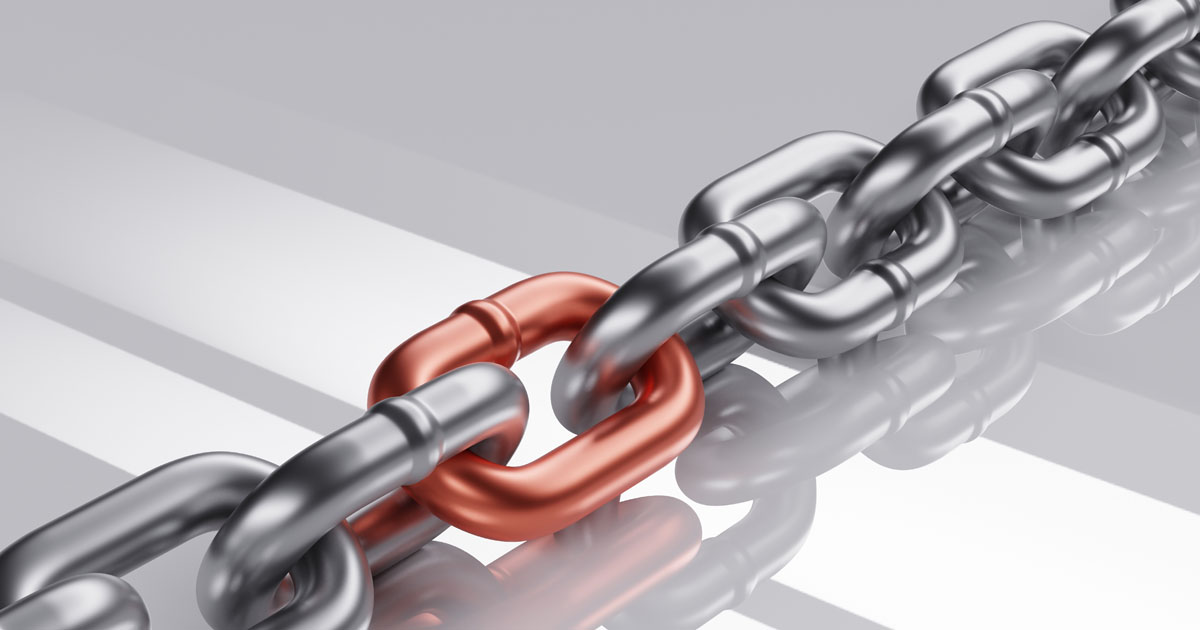
What is a chain? What types do we distinguish, and where can these be used?
You can get answers to these questions if you read our article. In its mechanical interpretation, a chain is nothing other than an assembly of interlinked rings or links, to each ring or link of which at most only two other rings or links are connected. We use the various types of chain primarily for power transmission and secondarily for fixing, safety and decorative purposes.
We can group chains as follows:
- Pin chain (Gall chain)
- Bush chains
- Roller chains
- Non-standardised types used in practice
Pin chain (Gall chain):
It consists of unhardened plates, which are joined into chain links by hardened, solid pins of greater strength. The ends of the pins are secured by riveting, and at larger diameters with a washer and split pin. Their construction is simple; they are used on cranes for lifting loads and in draw benches for moving the formed workpiece. As chain drives, they are used only at low speed (up to <0.3 m/sec).
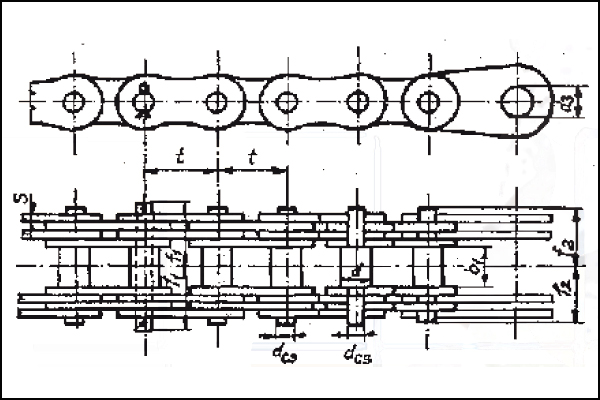
d: the largest diameter of the pins
dcs: the diameters of the pins reaching into the plate
d3: the bore diameter of the connecting end
b1: the inner distance between the plates
f1: the distance of the ends of the connecting pin from the chain centre
f2: the distance of the pin ends from the chain centre
g: the largest width dimension of the plates
s: the thickness of one plate
t: pitch
Bush chains:
They are used mainly for drives in rough service. There are two kinds of plate in the chain. The inner plates are pressed onto the bushes and the outer plates onto the ends of the pins, and the pressed fits are secured against rotation by machined, parallel flat surfaces. When the chain takes up the rotary motion of the drive wheel, the pin fixed in the outer plate and the bush fixed in the inner plate contact each other over a large surface; consequently the load acting on the pins has a significantly more favourable distribution than with Gall chains. Such types are, for example, pin drive and traction chains.
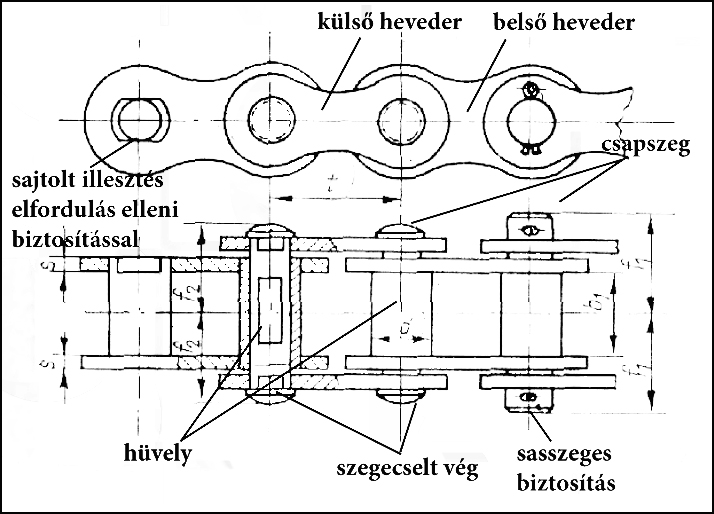
d: largest diameter
b1: the inner distance between the plates
f1: the distance of the ends of the connecting bush from the chain centre
f2: the distance of the bush ends from the chain centre
s: the thickness of one plate
t: pitch
Roller chains:
In the case of greater power transmission and chain speed (up to 15 m/s) roller chains are used, whose construction is similar to that of bush chains. Against loosening, the pins and the bushes are secured by their tight fit into the chain plates. Onto the parts of the bushes enclosed by the inner plates, which contact the teeth of the chain wheel, a loosely fitted roller is drawn, so the chain does not rub on the teeth but rolls (friction is only within the chain, between the bush and the roller). Roller chains are made in two qualities: a) of lower-strength unalloyed steel for ordinary chain drives, b) of high-strength alloyed steel for drives of higher speed and performance. In the case of alloyed steels a smaller cross-section is permissible, and consequently their weight per running metre is lower. The links are stronger, so at the same drive speed a greater circumferential force is permissible. Such are, for example, the roller traction chain and the running-roller traction chain. For transmitting greater circumferential forces, two- and three-row chain drives are also made, e.g. three-row roller chain. If, in the case of a greater force effect, more than three rows are needed, then two two- or three-row chains are placed next to each other.
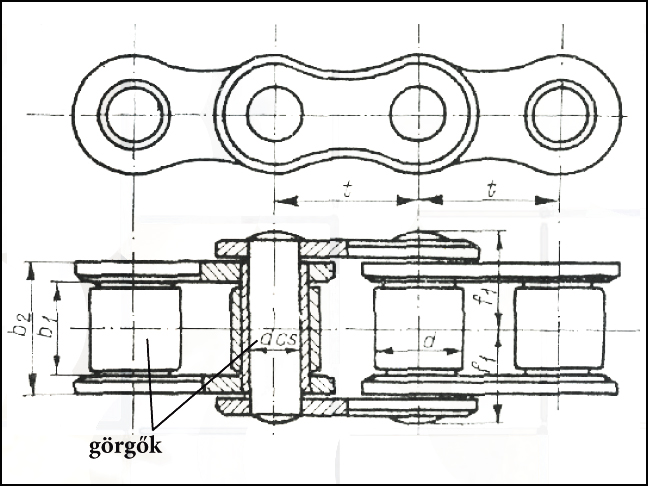
d: the largest diameter of the rollers
dcs: the diameters of the rollers reaching into the plate
b1: the inner distance between the plates
b2: the outer distance between the plates
f1: the distance of the ends of the connecting roller from the chain centre
t: pitch
Toothed chain
A type applied for high-speed drives. It is a drive chain whose plates are fitted with teeth on the inside. The plates placed next to one another are joined by pins. The teeth of the chain wheel are formed at such an angle that the teeth of the chain can bear on the full side surface of the teeth at once, and this ensures quieter engagement. This is why these chains are also called silent chains. The chain types according to the design of the pins joining the plates are: pin toothed chain, insert-bush toothed chain and rocker-joint toothed chain. The most economical chain speed is 6–7.5 m/sec. With even torque transmission and good lubrication, a chain speed of 10–15 m/sec is also permissible for a good quality toothed chain.
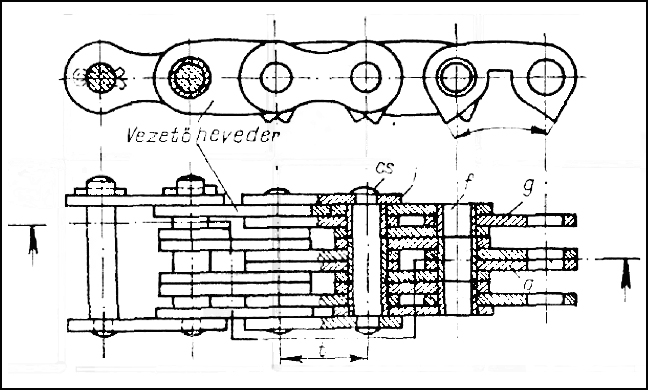
cs: the length of the pins
i: the thickness of one plate
f: the diameter of the bore
g: the largest width dimension of the plates
t: pitch
Besides those described so far, other chain types are also widespread, such as the
The simplest and oldest type is the link chain
It is made from steel wire by bending and welding on special chain-making machines. Link chains are used for lifting and suspending larger loads. In modern architecture stainless and acid-resistant link chains are often used, for example for the drainage of eaves, as a room divider or as a decorative cordon.
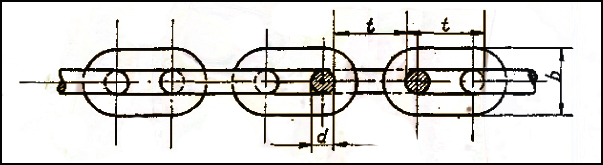
d: link thickness
t: the distance of the links relative to one another
b: the largest outer width of the links, which are manufactured from bar stock by cutting to length, bending and hot or resistance welding carried out along the contacting surfaces.
Making chains endless
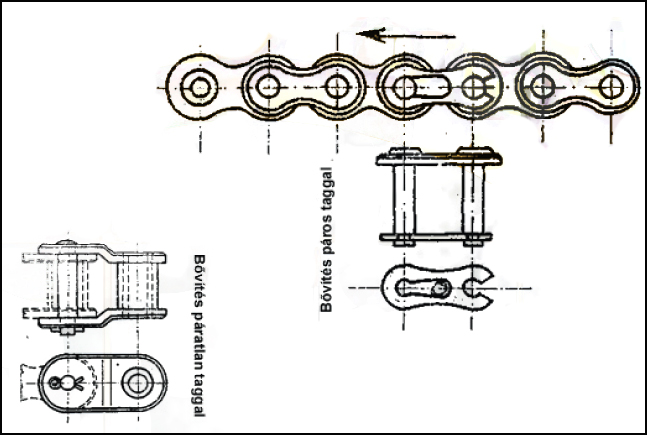
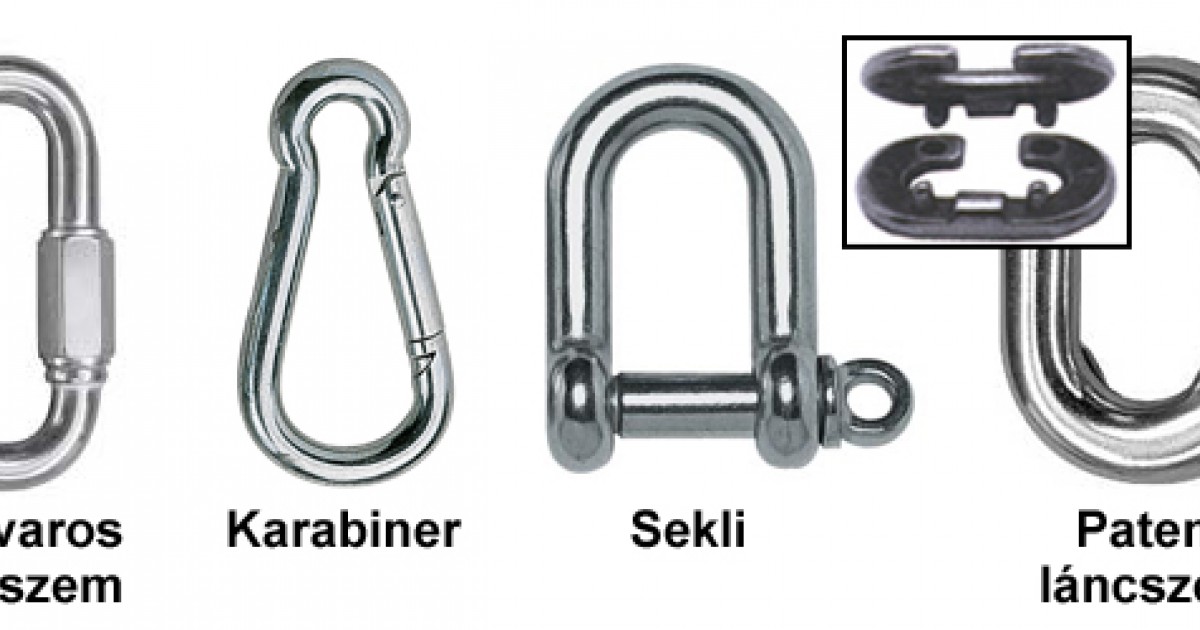
It can be solved simply in several ways. Link chains are made endless at the factory — in the required length. Certain types (e.g. the hook chain) can be assembled from links, so they can be made endless at any time, in any desired length. The construction of most chains requires the chain to consist of an even number of links, since adjacent chain links differ from one another and only every second link is identical. Smaller roller chains are made endless with so-called snap links, which are in turn closed by “U”-shaped flat springs. These “U”-shaped springs are snapped into the grooves formed at the end of the pins. Where the chain has to be made endless with an odd number of links, a bent, plate-type connecting link is applied, which can most simply be secured against the pin falling out with a split pin. Now that we have roughly become acquainted with the various chain types, let us turn back to the subject of the fields of application of the device, and look at a few practical examples.
Chain hoist, chain block
A load-lifting structure that can be suspended at any desired place, fitted with a crane hook and a moving chain wheel. The load hung on the hook is distributed over the standing and moving side of the pin or calibrated link chain thrown over the chain wheel. The moving chain side is moved by a chain nut fitted with a chain guide, or a screw drive, embedded between the shield plates of the chain hoist, which is secured by an automatic ratchet brake mechanism. Its drive is manual, by means of a calibrated link chain. It is a simple, undemanding structure, its weight is low, it is easily relocated, and it is suitable for loads of 0.125–10 t. Its disadvantage is that it is slow, and therefore its efficiency is not satisfactory.
Chain well
A manually driven structure operating on the principle of volume displacement, for raising the water of wells. The water is raised to the surface by pistons fixed to an endless chain and moving in a vertical pipe.
Chain scraper, chain drag scraper conveyor:
A material-handling machine conveying large-lump or fine-grained bulk material by damming in an open, horizontal or inclined trough, with scraper plates fixed at a distance of 0.4–0.8 m from one another to a plate or link chain or a steel rope. Its length is generally 50–100 m, its capacity approx. 100 m3/hour.
Chain brush
A cleaning device preventing the clogging of the sieve mesh of the semolina cleaning machine. Straight brushes of a length matching the width of the sieve covering are fixed at their two ends to endless chains, and their movement takes place with these beneath their sieve surface. Its disadvantage is that a separate drive device is needed to operate it.
Literature used:
Műszaki Lexikon
Editor-in-chief: Polinszky Károly
Akadémia Kiadó, Budapest 1972
Leave a Reply