
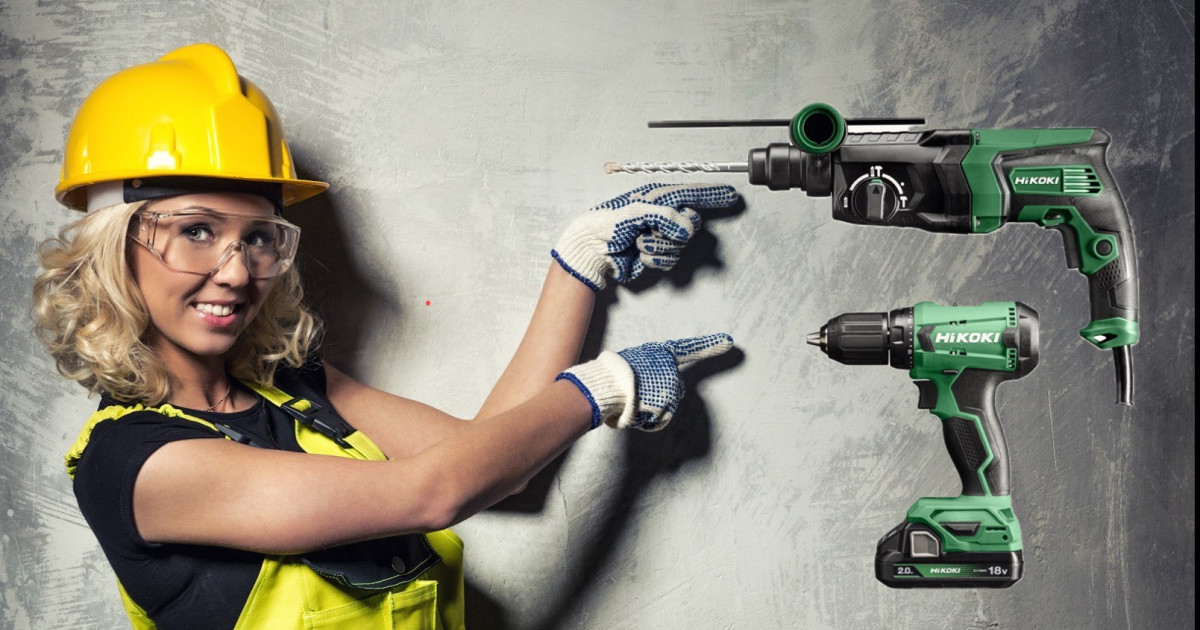
Home DIYers , and even the pros, sometimes agonise over whether to choose a cordless or a corded tool. Both types have their own advantages and drawbacks. Let us see which is the better choice, and when!
Frequency of use
It is worth choosing cordless tools if we use them regularly, repeatedly. If, however, they only come out relatively rarely, then the corded versions may be better, because batteries can deteriorate over time if we do not use them regularly.
Length of working time
If we have to work for long hours, corded tools are ideal, because we do not have to worry about the batteries running flat. If our decision nevertheless falls on a cordless tool, it is worth keeping several charged batteries to hand so that we can work continuously.

Accessibility
In places that are hard to reach, on outdoor jobs, or in areas where there is no power source, cordless tools offer greater freedom and greater safety at work.
Safety
Cordless tools reduce the risk of accidents, since there are no coiling cables to watch out for and they cannot end up underfoot or under wheels, so the work can be safer.
The vagaries of the weather
On outdoor ground where the unpredictability of the weather is also a consideration, cordless tools are more convenient, since there is no need to worry about power sources and extension leads.
-
1. No cable – fewer sources of danger
In a damp environment, extension leads and electrical cables present an increased risk of electric shock. With cordless tools no external power source is needed, so direct contact with moisture can be avoided. -
2. Flexibility and mobility
In the rain one generally has to work faster and more purposefully – cordless tools are easier to move about and do not get caught up in cables. A dry, sheltered spot for taking power is not always to hand. -
3. Safety of the tool and of the work
A well-insulated cordless tool tolerates damp and rain better than a corded tool fitted with an extension lead. There is no need for waterproof covering or an IP-protected cable connection.

When can the corded tool nevertheless be better?
In an enclosed or covered, well-insulated work area, where a dry, safe power supply is assured and longer, uninterrupted work is needed, the corded tool can be more advantageous – especially if the work is otherwise irregular, because batteries require regular charging and discharging for the sake of a long service life.
A note on the nature of use
Cordless hand tools used to be recommended mostly for light, quick jobs, while corded tools were held to be suitable for more serious, industrial use. That distinction has gradually receded into the background by now. Modern cordless tools – given adequate power and battery capacity – can perform almost every task that used to be done exclusively with corded tools. Although the nature of use may still be an important consideration in special working environments, the basis of the choice today is far more the location of the work, accessibility, safety, and the continuity and frequency of the work.
Cordless vs. corded tools
Here is a table for a quick overview of the considerations listed
| Consideration | Cordless tool | Corded tool |
|---|---|---|
| Risk of electric shock in precipitation | Low (no cable) | Higher – a cable in contact with water can be dangerous |
| Freedom of movement on wet ground | Excellent – no obstructing cable | Limited – the cable can snag, can be in the way |
| Power supply requirement | Requires no external power source | Requires a continuous power supply |
| Suitable for longer work | Limited, because of battery capacity | Ideal for longer, continuous use |
| Need for protection | Less sensitive, no external connection | Increased protection needed against moisture |
| Presence of cables | No cable – safer | Cable present – calls for caution |
| Frequency of use | Ideal alongside frequent use; the battery requires frequent use | More suitable for less frequent use, because the battery service life does not decrease |
| Nature of use – does it influence the choice? | Not a disqualifying factor – with the right choice of tool it is suitable for any task | It used to be decisive, today it no longer is – the circumstances matter more |
Did you find the article useful? Read our posts on similar topics too:
A loyal hand tool for loyal customers Special tools for machining stainless steel Angle grinder test

Leave a Reply