
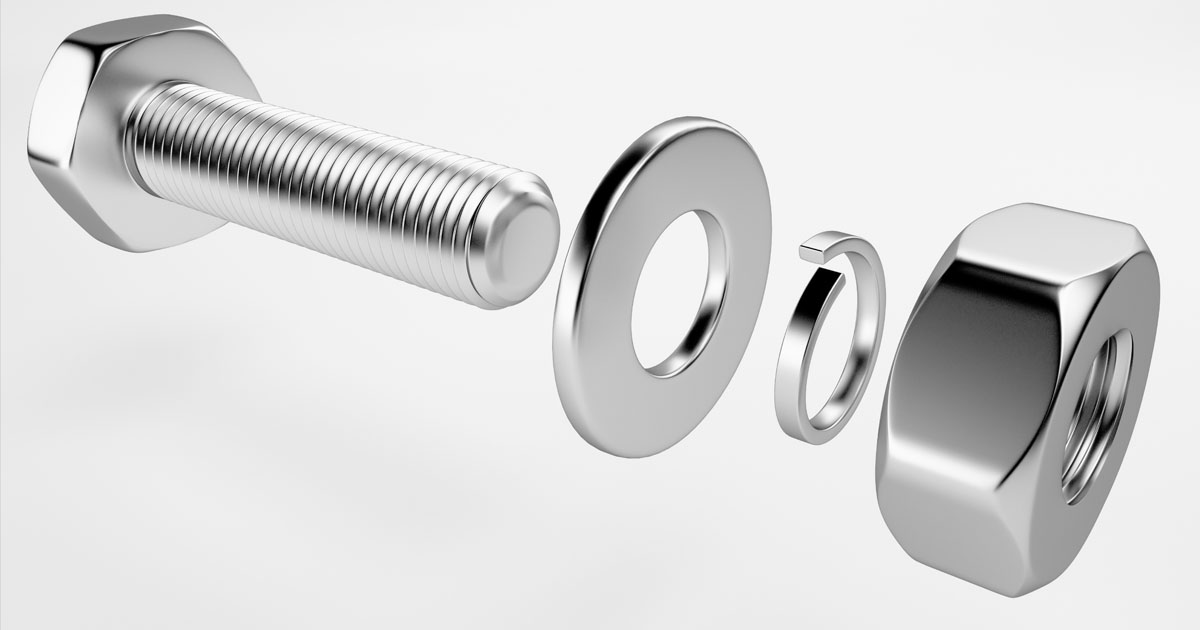
The washer’s most important job in a bolted joint is to spread the force acting on a single point. Without a washer, the torque applied to the screw would be concentrated on a small area, and that would destroy the part. The washer spreads this force over a larger area. Decent of it, isn’t it? You can feel this best when you drive a screw into wood or thin sheet. The screw practically tears the material apart. It is rather like wading knee-deep in snow — but if you then increase the surface area with a ski, you sink in less, because the ski spreads the load over an area far larger than your sole.
The washer’s other important job is to protect the surface of the workpiece. The screw does not turn on the finished surface, damaging it, but on the washer. We use “washers” in other areas of life too: we put a pallet under goods, a rug under chair legs, a sole under our feet, a saucer under the coffee cup, and each has its own washer function. It rather suggests itself that with all of these, not only the size of the surface but also the quality and thickness of the material are decisive factors. It is the same with washers. So let us look at the variants!
Types of washers
Different jobs call for different washers. These are the types we use most often:
|
|
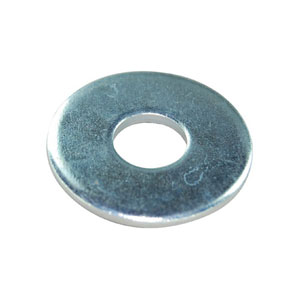
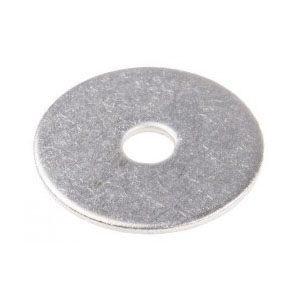
For wood we use wide, so-called wood construction washers (DIN 440, DIN 1052, DIN 9021, AFONOR 611 LL etc.). Wood construction washers exist in round and square (DIN 436) versions, but this is mostly just an aesthetic question. The individual variants differ mainly in the ratio of outside to inside diameter and thickness. We asked a woodworking customer why they favour one type or the other, and the answer was that they use the one it is easier to get a drill bit for. In design work, fixed size ratios make the designer’s job easier — with DIN 9021, for example, the outside diameter is three times the hole diameter, which is easy to calculate with… Fortunately we have a wide range of wide washers, both wood construction and other types. We can even supply a wood construction washer with a square hole, specifically for under the head of coach bolts, which of course have a square neck (DIN 440V). |
|
|
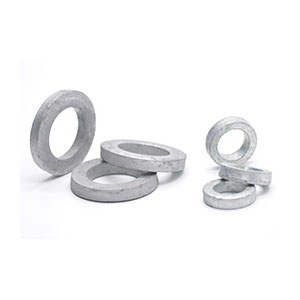
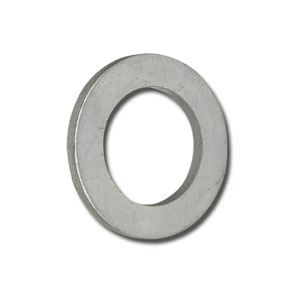
For high-strength joints the thick washer (DIN 7989) is the right choice. Here, then, the larger role is played not by a wide bearing surface but by being able to reach the bolt head with the tool at all, and to tighten it properly or indeed loosen it again, while protecting the surface of the structure from damage. |
|
|
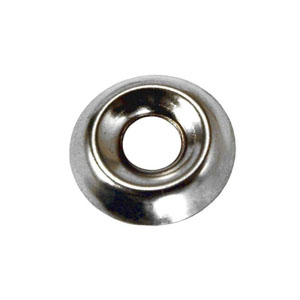
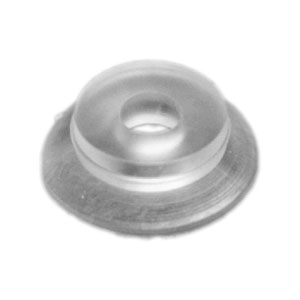
For countersunk or raised countersunk head screws the decorative washer (Item no. 9081) is the one to use; the countersink of the screw seats into it exactly. It is used primarily on mirrors, on upholstery and on leather surfaces. Besides its aesthetic appearance it also has the role of stopping the screw from rucking up or tearing through the surface, clamping it down evenly instead. Why not a dome head screw with a flat washer? That is an option, but a handsome decorative washer is still more attractive than a flat washer. Two variants have become widespread, the cheaper sheet version and the more expensive turned version, between which there are differences not only in price but also in aesthetics and function. To mention just one, the turned version, for example, bears over its full face, while the version pressed from sheet bears only on a thin outline – which is neither better nor worse, simply something we have to take into account. |
|
|
For fitting thin sheets, body washers (Item no. 9054) are available in a wide size range. |
|
|
For fitting sheet claddings and corrugated sheets we recommend sealing washers (Item no. 9055), which are a combination of a slightly conical metal disc and an elastomer (e.g. Neoprene or EPDM) vulcanised onto its inside. During assembly the screw head presses the cone down and the vulcanised-on rubber bulges out: towards the screw shank into its thread, and around the edges of the washer it is pressed onto the surface of the workpiece, thereby sealing the fixing point. |
|
|
Contact and insulating washers are used in electronics. Contact washers increase the conduction of the joint point, while insulating washers eliminate it. There are also insulating washers that are not just a disc but insulating material enclosing the screw shank and even the screw head. Do feel free to request a quote! |
|
|
Washer for cheese-head screws (DIN 433). Cheese-head screws are bodies of revolution, often fitted in tight spaces, for example through blind holes in castings, so the washers cannot have a much larger diameter than the screw heads themselves. |
|
|
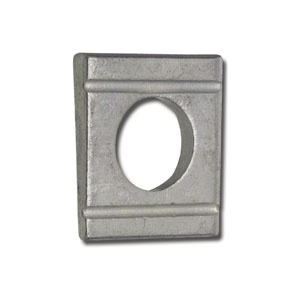
Washer for U and I beams. These washers follow the slope of the surface of the section steel. The U washer (DIN 434) compensates for the thickness difference of the section steel with an 8%, the I washer (DIN 435) with a 14% difference in thickness. Thanks to the washer, the bolt can be driven in perpendicular and bears on the U or I section over its full face. The hole diameter of these washers is larger than that of every other kind of washer precisely because a hole wider than the diameter of the bolt shank easily lets through even a bolt arriving at a not-quite-perpendicular angle, whereas in a narrow hole a bolt entering askew would be far more likely to jam. |
|
|
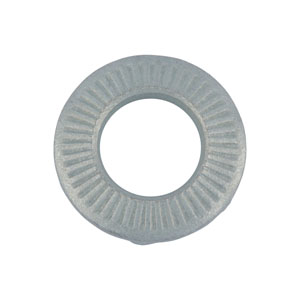
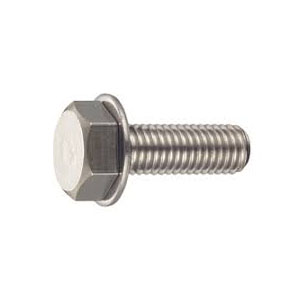
Captive washers do not fall off, because the thread is rolled onto the screw shank afterwards, which increases its diameter, so the washer can no longer drop off over the thread. It can be a flat, spring, serrated or wave washer, or a combination of these; the point is that everything is where it needs to be, and on top of that it saves us a lot of time and trouble in production! Heavy machinery, sports motorbikes, martial arts, football and the rest of the boys’ turf – women keep up with everything these days. Why would it be any different with screws? If a captive washer-and-screw exists, why should a washer-and-nut combination not exist too? It very much does, and it is called a combi nut (item no. 9085), onto which the washer is flanged so that it turns freely but cannot fall off. Very practical. |
The washer and the amoeba
What could be simpler than a washer? – as if it were the symbol of the single-celled organism – and yet, despite that, or perhaps precisely because of it, we come across a huge variety of washers in everyday life. Washers, which are mass-produced by stamping from coiled strip or from sheet, theoretically satisfy every user requirement in such a wide range. When practice differs from theory, however, the user has the option of ordering a custom washer to their own requirements; they only have to specify the dimensions, the material grade and the quantity. Use stainless washers with stainless screws, and acid-resistant washers with acid-resistant screws! There is no saving to be made here, because the price difference that could be “saved” is far too small; what you do need to know is that the wrong material grade can ruin the entire structure!

Leave a Reply