
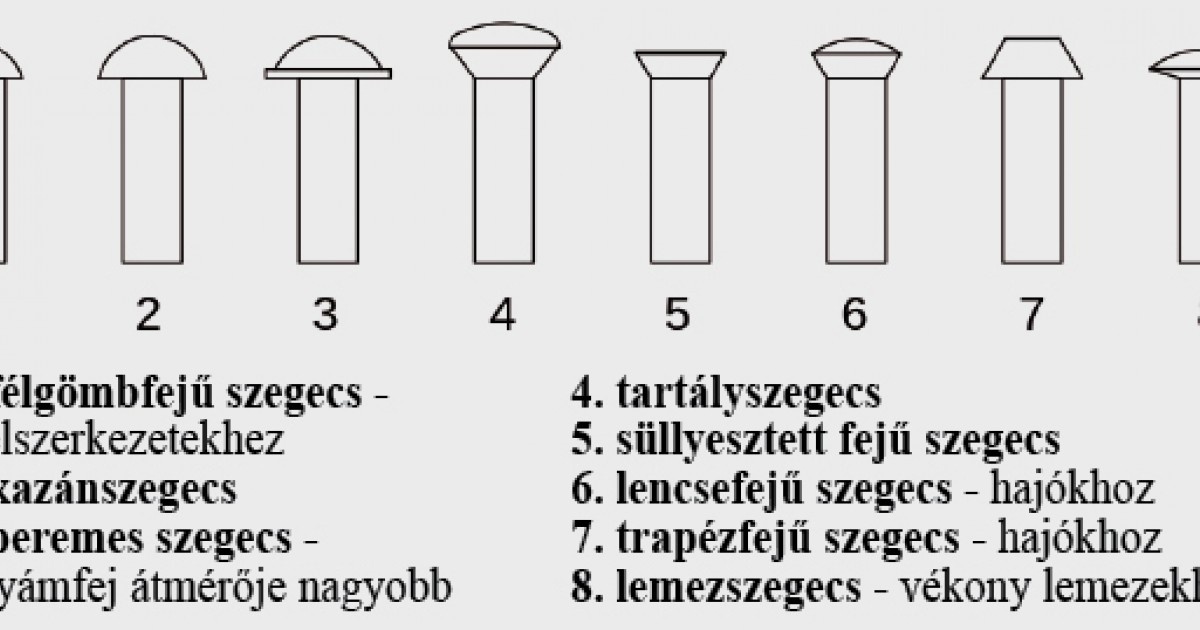
The rivet is a fastener used mainly in mechanical engineering and in steel structures. A riveted joint is a joint made between two overlapping sheets or sheet-like parts that cannot be undone without destroying it. The classic rivet is a mostly steel part consisting of a cylindrical shank and a head of various shapes. The head on one side of the rivet is formed in advance; this is called the factory head. For riveting, the sheets to be joined were drilled (preferably together) — at smaller diameters, in less demanding cases, they were punched — the rivet was threaded through, and depending on the dimensions and the material grade it was forged together cold or hot. In the 19th century, apart from the bolted joint, practically only the riveted joint was suitable for fastening sheets together. A rivet inserted while glowing hot and then forged down undergoes restrained thermal contraction as it cools: the clamped elements do not allow it to shrink lengthwise, so stress builds up in it and it clamps the elements together with great force. Radially, nothing prevents the shank from shrinking, so a gap forms between the hole and the rivet shank. A joint like this can transmit a force perpendicular to the rivet axis only by friction. Riveted joints were already used in the Bronze Age; in structures made of iron, riveted joints were usually made by blacksmiths. From the Industrial Revolution until welding came into widespread use, pressure vessels, boilers and steel structures (bridges, lifting machines, building frames, ships) were made by riveting.
Steel rivets
Traditional steel rivets were heated to red heat in a forge fire, then the rivet was pushed into the prepared hole, the head of the rivet was held from one side, and from the other side the protruding cylindrical end of the rivet was forged down with a concave hemispherical tool. Smaller joints were riveted by hand; for larger rivets a pneumatic hammer was used. There are also hydraulic or mechanical purpose-made tools with which a single operator can carry out the operation. These are U-shaped devices that can straddle the sheets and the rivet. Their drawback is that they can only be used in easily accessible places. Bridges and steel structures of riveted construction are assembled from larger pre-assembled girders, so only a few joints need to be made on site. A small forge hearth is set up near the assembly point, heated with charcoal by the centuries-old method of village blacksmiths. The rivets to be fitted are placed among the embers. At the assembly point, which may be several metres away, the hole is prepared. On request, the blacksmith standing at the hearth lifts a glowing rivet out of the fire with tongs and throws it to the riveter, who catches it in a tin catching funnel, inserts it into the hole and holds against the factory head with a suitable tool, then forms the closing head with the pneumatic hammer.
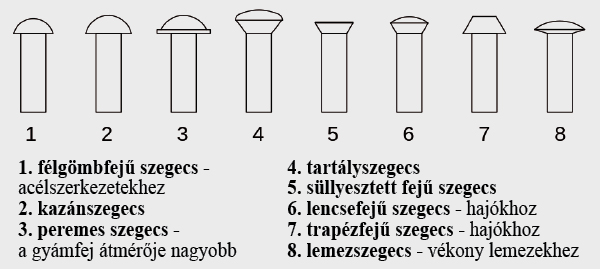
Special rivets:
Tubular rivet: a thin tube, one end of which is flared in advance and the other during assembly. It can only be used for lighter loads; it is common on leather goods (belts, shoes) and on clothing (jeans).
POP rivet: also a type of tubular rivet, into which a mandrel is fitted, made at one end with a head of larger diameter than the tube bore, while its other side is formed as a factory head. During assembly the rivet is placed head first into the hole, then the mandrel is pulled out with special pliers while the other half of the tool holds against the rivet. The head then deforms the other side of the rivet and so fixes it. The advantage of the POP rivet is easy and quick assembly, and the fact that this rivet only has to be accessible from one side.
Drive chains: to connect their links, machined rivets are used whose middle cylindrical section is of larger diameter than the rivet shank; this keeps the distance between the links on either side. These rivets have no pre-formed factory head; the heads on both sides are pressed during assembly.
Aircraft: the sheet skin, which on monocoque structures is not simply a covering but also a load-bearing element, is fitted with special rivets that sit flush with the outer surface in order to reduce drag.
Source: Wikipedia

Leave a Reply