
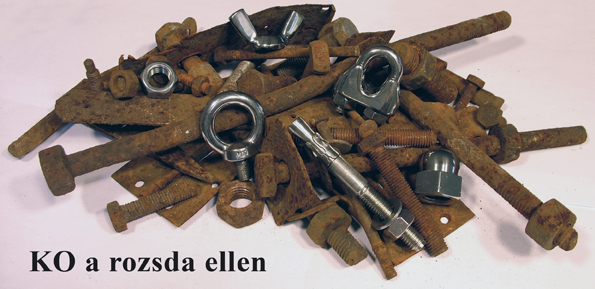
By definition, corrosion is the destruction of metals and their alloys by means of an electrochemical process, during which the metal forms a compound with a non-metallic element. The Latin-derived word corrosus — meaning bitten away, eaten bite by bite — expresses well the destructive nature of corrosion. Under normal conditions the reaction of a metallic and a non-metallic element only takes place if the non-metallic element is in aqueous solution.
In a dry medium iron does not rust. Inside the Egyptian pyramids, thanks to the dry desert climate, several-thousand-year-old objects of everyday use made of iron have been able to survive.
The process of rusting — a little electrochemistry
If we immerse a piece of metal in a solution, positively charged metal ions migrate from its surface into the solution and leave behind in the metal a number of electrons corresponding to their valency. As a result the metal becomes negatively charged. At the same time an opposite process is also taking place. The metal ions already in the solution seek to deposit on the surface of the metal, the more so the more of them there are in the solution. After a time the two processes reach equilibrium. This state is called the electrochemical standard potential. The potential cannot be measured in itself, only the potential difference, which is why the convention arose that the potential of the hydrogen electrode is taken as zero and the potential of the other metals is related to this. Some metals send more ions into the solution than hydrogen. Iron, zinc and lead are such. Another group of metals are less prone to dissolution, such as silver, gold and platinum.
The galvanic cell and corrosion
When metals of different potential end up in a common solution in such a way that there is an electrical connection between them outside the solution, the process of dissolution takes place at a dramatic rate. If we immerse a zinc and a copper rod in the same electrolyte, the less noble zinc sends more ions into the solution than the copper, so more electrons remain in the zinc, which gives it a stronger negative charge than the copper. If we connect the copper and the zinc rod outside the electrolyte with an electrical conductor, the electrons will flow towards the less negative copper. With this the zinc loses some of its charge and sends yet more positive zinc ions into the solution, as well as electrons towards the copper. While electric current flows in the external conductor, the dissolution of the zinc — which in any case dissolves faster — accelerates, and in parallel with this that of the copper slows. This is the principle of operation of the galvanic cell.
Local cells
Galvanic cells similar to the one described above unfortunately exist not only in the laboratory, but also form spontaneously in metal structures. The consequence: the corrosion of the less stable metal accelerates. Where different metals are in contact, the danger of a local cell forming must always be reckoned with. But the surface of heterogeneous-structured alloys is also a chain of local cells, because the potential of the differently enriched parts of the alloy will differ. A local cell also forms if there is a difference in the concentration of the electrolyte in contact with the metal. For example, in the case of metal objects immersed in water there is more dissolved oxygen closer to the water surface than in the deeper layers.
The damage caused by corrosion
Unfortunately most of the metals used by humanity are not in a stable equilibrium state when in contact with the atmosphere and water. The formation of the metal’s oxides and hydroxides creates a more stable state. Metallurgy produces the metal from its compounds by investing energy, and nature undoes this work by means of corrosion. While giving off energy, the metal seeks to transform back into the compound from which it was produced. Corrosion is in fact the reverse process of metallurgy. The damage caused by corrosion is of course far greater than the value of the metal lost in this way, since the corroding metal always perishes as the material of some structure or machine. We cannot stop corrosion completely, but we can slow the process. Certain metals, such as aluminium or lead, oxidise very quickly, but the oxide that forms adheres well to the surface of the metal and forms a continuous coating, a so-called passive layer. This layer saves the inner metallic parts from further corrosion, right up until this passive layer is damaged or dissolves in acid or alkali. Unfortunately the properties of the iron oxide that arises during the corrosion of iron, the most commonly used metal, are not like this. Iron oxide (rust) has a lamellar structure, crumbles easily and does not adhere to the surface of the metal. This is why iron objects are, after a time, lost to decay through their entire cross-section if we do not protect against rusting.
According to estimates, corrosion causes HUF 50 billion of damage a year in Hungary.
Corrosion must be protected against!
The following possibilities are available for this:
- By treating the medium causing the corrosion
- By electrochemical methods
- With protective coatings
- By applying alloys that resist corrosion
Treating the medium causing the corrosion:
We do not have much chance of removing oxygen and water from the environment of metals, since we cannot live without them either. But we can reduce the quantity of harmful gases (SO2, CO2, Cl2) reaching the atmosphere, which form acids with water and thereby accelerate the corrosion of metals. If we reduce the emission of these gases, we do good both to ourselves and to our metal objects.
Treating the medium is really only of significance in the case of closed systems, generally cooling or heating systems. If we make the liquid circulating in the system alkaline, we reduce internal corrosion. Removing the dissolved oxygen from the water is also an effective method. For this the water is passed over a material that reduces oxygen, for example iron filings. In this case the worthless, large-surface iron filings, while rusting themselves, extract the dissolved oxygen from the water.
The electrochemical method, otherwise known as cathodic protection
If we make the metal object to be protected into a cathode, corrosion can be significantly slowed. We can do this by connecting it into a circuit as the cathode, or by connecting it with a metal less noble than itself. This is most often applied for the protection of underground iron pipelines. The iron pipeline is electrically connected to magnesium blocks sunk underground. The magnesium anode of the galvanic cell that forms slowly dissolves, while protecting the iron from rusting. A 10 kg magnesium block is used up underground in approx. 40–50 years.
Protective coatings:
The task of protective coatings is to keep moisture and oxygen away from the surface of the metal. Only bright metal surfaces may be coated. In the case of a contaminated surface, corrosion can continue beneath the coating. The volume of the iron oxide that arises during the corrosion of iron is greater than that of the iron, so if the coating is not flexible enough, it cracks its surface open. This is called rust bursting.
A protective coating can be made from non-metallic materials. Paints, enamels, lacquers and plastics are such. But water-repelling greases and oils also provide temporary protection. The common characteristic of non-metallic coatings is that they electrically insulate the metal object.
The other kind of protective coating is when the iron is coated with a metal more resistant to corrosion, or the workpiece is made of stainless or acid-resistant steel from the outset. Metals that can be used as a protective coating are zinc, tin, nickel, chromium, cadmium, aluminium, silver, gold, platinum and titanium.
Because of its cheapness, zinc is used most often. This is what we call galvanising.
Hot-dip process:
The coating can be made by a hot-dip process, when the metal to be coated is immersed in the melt of the coating material. The thickness of the coating can be well regulated by the dipping time. The coating can also be made by spraying the melted coating metal onto the workpiece with the aid of compressed air. In the case of very small workpieces, where a very thin coating needs to be created, the metal is evaporated in a vacuum, with an electric arc discharge or with a laser, and it condenses on the cold workpiece. With this process a coating can be made from metals with a high melting point as well.
Electroplating:
The object to be coated is immersed in a bath containing the ions of the coating metal and is connected as the cathode of a direct-current circuit. From the electrolyte, by means of electrochemical reduction, a metal coating deposits on the cathode, that is, on the object to be protected. Where, alongside corrosion resistance, high wear resistance and hardness are needed, nickel or chromium is used as a protective coating. Both metals result in a bright surface, so they are also used decoratively.
Cladding:
It is used for the corrosion protection of sheets. The metal to be protected is cleaned, roughened, and the protective metal layer is cold-rolled onto it. The method is used mostly in aircraft manufacture, because high-strength aluminium alloys are not corrosion-resistant.
Multi-layer surface protection:
In the case of equipment used under extreme conditions, a non-metallic polymer* coating developed for this purpose is usually also applied over the metallic protective layer. By combining coatings, workpieces resistant to corrosion even under extreme conditions can be created. One such multi-layer surface protection is, for example, the surface-forming process bearing the trade names Delta Magni and Delta Tone. Alongside these, stainless and acid-resistant steels have a prominent role, as raw materials providing a high level of corrosion resistance in themselves.
You can read about alloys that resist corrosion in our next issue.
*polymer: a giant molecule built up from repeating units

Leave a Reply