
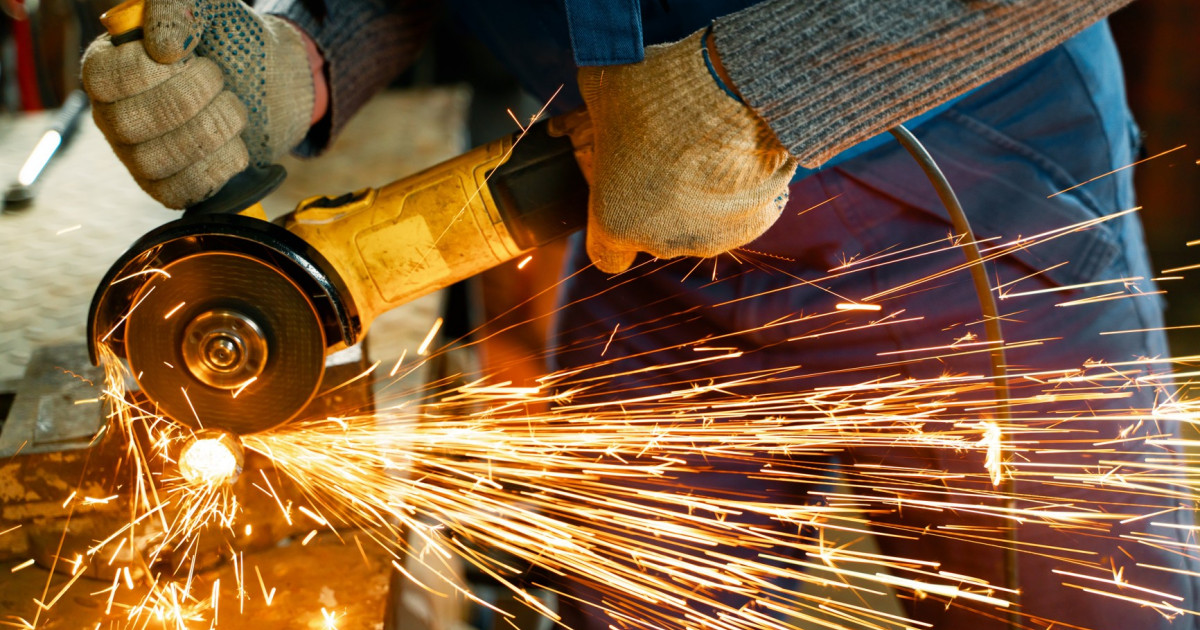
What happens while you are cutting?
The angle grinder spins the cutting disc at a high speed of 6,600 or 11,000 rpm. When the fast-spinning tool meets the workpiece, the friction that arises causes both the workpiece and the tool to start wearing. The particles that break away become white-hot and fly off in a shower of sparks in the direction of the disc’s tangent.
How is a cutting disc made?
The base material of cutting discs is always some kind of hard particle; these particles vary depending on the intended application. Generally speaking, the particles are always harder than the material to be cut, otherwise the disc would not cope with the material or would wear faster than the workpiece. These particles are pressed into a disc with a bonding agent and a safety mesh. During use, the particles of the cutting disc are torn out of the surface, and the bonding agent surrounding them wears too, which frees up further particles. This is why the cutting face of the disc stays abrasive even during use.
What makes a stainless cutting disc different?
During cutting, some of the particles breaking away from the tool may fuse with the cut surface of the workpiece. Conventional cutting discs may contain oxidative materials, which can later cause rust spots on the cut surfaces. This can later cause changes in the deeper layers of the material as well, but it certainly ruins the stainless surface, quite apart from being aesthetically undesirable. There are situations, for example in the food industry or the chemical industry, where this is entirely unacceptable. Naturally this statement is only true of products that are stainless and acid-resistant throughout (e.g. AISI 1.4301, 1.4303, 1.4541, 1.4571 etc.; for screws, A2, A4). Naturally, the cut surface of surface-treated (e.g. galvanised) steel products does not become protected from corrosion even when a stainless cutting disc is used; conversely, if we use a stainless cutting/grinding disc for machining stainless steels, it helps prevent corrosion from forming, and furthermore the oxide layer protecting the material’s inner structure re-forms on the surface of stainless materials after machining.
How can you ruin a stainless cutting disc?
It is very important to use the stainless cutting disc only on stainless materials! A single cut on a non-stainless workpiece and the stainless cutting/grinding disc can never be used on stainless materials again!
The reason is simple: the particles breaking away from the workpiece stick to the surface of the cutting disc, contaminate it, and when the next stainless workpiece is cut they “infect” the stainless steel, in which intergranular corrosion may develop.

Leave a Reply